
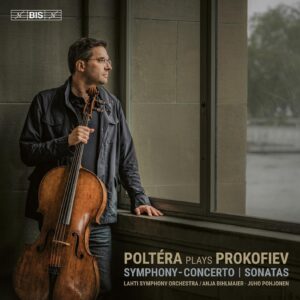
PROKOFIEV: SYMPHONY-CONCERTO, SONATA FOR CELLO SOLO, SONATA FOR CELLO AND PIANO, Christian Poltera. Lahti Symphony Orchestra, Anja Bihlmaeir/BIS SACD
Here is a welcome chance to once again experience a piece by Prokofiev which has long been something of a poor relation among his orchestral works – the Symphony-Concerto or, has it is also been characterised, the Sinfonia Concertante. The neglect of the piece is somewhat mystifying, as there is much of the composer’s vigorous and colourful orchestral writing on offer, even though the piece does not necessarily reveal all its secrets on one or two hearings. It’s hard to imagine either that piece or the companion pieces here given more persuasive adequacy than that of Christian Poltera, the Lahti Symphony Orchestra and Anja Bihlmaeir.
GERHARD: DON QUIXOTE, COMPLETE BALLET, ETC., BBC Philharmonic, Juanjo Mena/Chandos
Classical listeners of a certain age will remember when Roberto Gerhard’s music was occasionally played on the BBC, and what we were given back then was in the composer’s 12-tone era – music which was largely speaking unapproachable and uningratiating to anything but the trained ear. However, as with many composers who embraced a more forbidding later style in the serial era, the earlier music is much more approachable and winning, as this program suggests. In the beguiling Spanish apparel of the ballet Don Quixote, there are echoes of Ravel and Falla – some considerable distance from the composer’s later music. And it should be noted that the performance sports all the requisite dash for this early Gerhard, though it’s not in Chandos’s market-leading surround sound.
KHACHATURIAN: PIANO TRANSCRIPTIONS, Mikael Ayrapetyan, piano/Grand Piano
Dissenting voices notwithstanding, the appeal of the colourful, energetic scores of the Armenian composer Khachaturian cannot be denied, and his two celebrated ballets, Spartacus and Gayaneh, are immensely beguiling for their powerful melodiousness and driving dance rhythms. Both are represented here, but in a different form than listeners are used to: these are piano transcriptions, along with the famous Masquerade suite, and it would be understandable if admirers of the composer would – even before hearing the disc – opt for the scores in their original orchestral guise. And that would be a shame – Mikael Ayrapetyan, who is a leading exponent of Armenian piano music — makes the best possible case for these transcriptions, and his pianism throughout is impeccable. The orchestral originals will not be displaced, but there is certainly room for these highly musical transcriptions.
BARTÓK: STRING QUARTET NO. 3 (ARR. FOR STRING ORCHESTRA BY STANLEY KONOPKA) SUITE FROM THE MIRACULOUS MANDARIN, Cleveland Orchestra, Franz Welser-Möst/Cleveland
The Cleveland Orchestra have supplied striking new audio recordings of two works by the Hungarian master Béla Bartók: his String Quartet No. 3 (arranged for string orchestra by Cleveland Orchestra Assistant Principal Viola Stanley Konopka) and the suite from The Miraculous Mandarin. Led by Music Director Franz Welser-Möst, the recording is available worldwide for digital streaming and download in spatial audio on all major platforms. As Welser-Möst noted: “Bartók creates a new musical path forward by masterly combining influences from folk tunes and elements of the avant-garde.”
JOHN ALDEN CARPENTER: COMPLETE BALLETS, Boston Modern Orchestra Project, Gil Rose/BMOP
Celebrating its milestone 100th album, the Grammy Award-winning Boston Modern Orchestra Project (BMOP) led by conductor Gil Rose releases John Alden Carpenter: Complete Ballets. For the first time, all three of Carpenter’s seminal ballet scores—Krazy Kat, The Birthday of The Infanta, and Skyscrapers—are presented in their complete and original form. As one of the first American composers to see the importance of ragtime and, later, jazz, and to use their rhythms in his compositions, Carpenter wrote music that reflected the culture of American milieu of his times, and the sounds of modern American life, as displayed on this “tour de force” disc. Gil Rose noted: “When considering the 100th album, I wanted something that showed off the orchestra’s ‘chops’ and sense of style” – an ambition he clearly accomplished.
MEYERBEER: LE PROPHÈTE, Soloists, London Symphony Orchestra, Mark Elder/LSO Live SACD
Certain operas – massively popular in their day – have a way of falling off the radar. It’s hard in the 21st century to realise just how popular Meyerbeer’s Le Prophète was – and such was its celebrity that it inspired resentment in the composer’s rival, Richard Wagner. Of course, history has made it clear who the greater composer was, but it is particularly welcome to see the piece title given such a powerful advocacy in the modern age, not least in the kind of all-enveloping surround sound that is one of the great characteristics of LSO Live recordings. And it’s hard to imagine the piece being better performed. Recorded live in concert at Festival d’Aix-en-Provence in 2023, this set has London Symphony Orchestra, conductor Sir Mark Elder and a forceful cast of soloists energising Meyerbeer’s visionary historical drama.
AN DIE MUSIK, Torlieff Thedeen, cello, Marianna Shirinvann, piano/Lawo
This program of music for cello by Brahms, Robert and Clara Schumann Schubert and Richard Strauss is immensely winning in the hands of Torlieff Thedeen, cello, Marianna Shirinvann, piano. Every nuance of these beguiling scores is coaxed out in readings of consummate musicianship.
DANIELPOUR: SONGS IN THREE LANGUAGES, Soloists, Iranshar Orchestra, Sharab Paranj/Naxos
More adventurous listeners will be familiar with the music of Richard Danielpour from issues on a variety of labels, and it’s clear that the composer is of the particular modern school that has no intention of alienating its audience, writing dynamic and fully approachable music that does not compromise on commitment and intelligence. The vocal pieces on this disc are not necessarily in the same idiom as his orchestra work in terms of structure, and while not immediately offering up their clandestine secrets, repay close attention and multiple listenings. Performances are top notch.
VERDI: AIDA, Soloists, Orchestra of the Royal Opera House, Antonia proponents/Opus Arte Blu-ray
Verdi’s popular masterpiece, composed for the opening of the Suez Canal, has enjoyed several impressive iterations in the DVD (and even Blu-ray) media, but few have the sheer dash and vividness of this new set with Elena Stikhina radiant in the title role. A winning factor for many will be the crystal-clear resolution of the image in this impressive set which is matched by impactful sound that does full justice to the score, though the eccentricities of the modern dress staging will not be to every taste.
BROUWER: THE ART OF SAILING AT DAWN, SYMPHONY NO. 1, ‘LAKE VOICES’, ORF Vienna Radio Symphony Orchestra, Marin Alsop/Naxos
Margaret Brouwer’s work will not be familiar to many, particularly in the UK. But in America, she is known for her commitment to lyricism and vivid orchestral imagery. This programme, in the capable hands of Marin Alsop, makes strong cases for the pieces on offer, particularly the First Symphony which sports a Dutch hymn-like melody and confident, colourful orchestral writing.
MAHLER: SYMPHONY NO. 3, Minnesota Orchestra, Osmo Vänskä, BIS SACD
The success of this latest issue in a new cycle of Mahler symphonies has far outweighed the less-than-enthusiastic response some of the earlier entries gleaned, and so it once again proves with this remarkable performance. Earlier SACD readings of the Third Symphony that enjoyed great acclaim – such as those by Pierre Boulez and Ricardo Chailly — are no longer available, appearing on labels which have long since abandoned their commitment to surround sound, so the jockeying for position now takes place in a less crowded field. Vänskä once again demonstrates that he has the full measure of Mahler’s music, encompassing the world (as Mahler suggested the symphony should do), with a soloist fully equal to the vocal demands of the music in mezzo soprano Jennifer Johnston. The recorded sound is well within the impeccable BIS parameters – that is to say, full of both inner detail and massive impact when required.
(and see Graham Williams’ review opposite)