
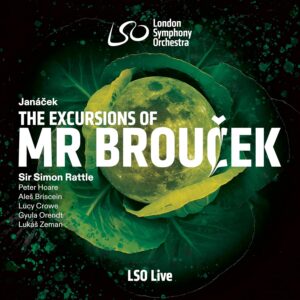
Leoš Janáček’s ‘The Excursions of Mr Brouček’ may be one of the composer’s least frequently staged mature operas, but this concert performance by the London Symphony Orchestra under Sir Simon Rattle, recorded live at the Barbican Hall on 4 and 6 May 2025, makes a compelling case for its musical riches. With a superb cast, an outstanding contribution from the Tenebrae Choir and an orchestra playing with remarkable clarity, colour and vitality, this is a performance that reveals just how astonishingly inventive Janáček’s score is.
Rattle’s particularly strong affinity with the composer is already well established from the previous releases in his Janáček opera cycle with the LSO, and his interpretation here is distinguished by both clarity and an exceptional ear for orchestral colour. The score’s restless rhythms, abrupt juxtapositions and sharply etched instrumental gestures are handled with precision but never rigidity. Rather than allowing its episodic structure to become disjointed, Rattle finds ways of giving the music an underlying unity. The result is a performance of considerable refinement in which every detail seems to have its place.
The LSO respond magnificently. From the technically demanding opening, the orchestra displays an extraordinary degree of transparency on this recording. The strings are clear and incisive, while the brass has both brilliance and weight. Janáček’s orchestration is packed with sudden contrasts and unexpected combinations, and Rattle seems determined to reveal every one of them.
At its centre is Peter Hoare’s outstanding portrayal of Mr Brouček. This is a demanding role, both vocally and theatrically, and Hoare inhabits it with tremendous energy. His performance captures the character’s absurdity and pomposity without reducing him to a caricature. Vocally, Hoare is consistently impressive, negotiating Janáček’s speech-inflected writing with clarity, flexibility and stamina.
Aleš Briscein brings a bright, penetrating tenor to Mazal, with an upper register that remained strong and secure. Lucy Crowe is equally impressive, moving between her several roles with remarkable vocal versatility. Her silvery soprano is ideally suited to the music, combining radiance with an expressive warmth that makes her contribution particularly memorable.
The demands on the excellent supporting cast, in which almost everyone changes roles, are considerable, yet the ensemble maintains impressive cohesion throughout. The accurate placement of the singers across the soundstage on this recording makes identifying who is singing considerably easier.
Tenebrae, directed by Nigel Short, is another major asset. The choral writing is delivered with precision and tonal focus that few opera house choruses could achieve, while the male voices make a particularly strong impact when Janáček expands the musical scale. The change in character required later in the work is achieved with impressive stylistic control, and the recording captures the chorus with sufficient presence to give its contributions real weight without overwhelming the soloists.
LSO Live’s presentation is first class. A lavish 160-page booklet includes artist biographies, photographs from the performances, programme notes and a helpful synopsis of the opera from Nigel Simeone but, most importantly, a full Czech/English libretto.
The performance demonstrates that beneath the opera’s eccentricities lies a score of extraordinary originality. In Rattle’s hands, and with an orchestra of the LSO’s calibre, Janáček’s music emerges as vivid, sophisticated and irresistibly alive.
In every respect, this is a cherishable recording.