
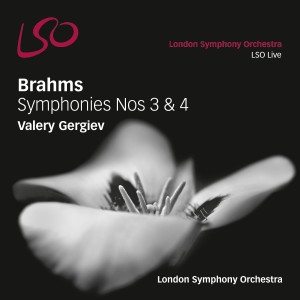
BRAHMS: SYMPHONIES 3 & 4, LSO, Valery Gergiev/LSO Live SACD LSO 0737 The recording of two Brahms Symphonies that occupy this SACD stem from performances by the LSO under Valery Gergiev given at the Barbican in December 2012. At these concerts Gergiev paired Brahms Symphonies with those of Szymanowski – an idea that many might regard as a bizarre piece of programming. However, the latter have already appeared on the LSO Live label no doubt helping to increase the listening public’s awareness of the fine music by an unfamiliar Polish composer. Brahms needs no such advocacy and with a catalogue bursting with recordings of Brahms Symphonies from some of the greatest conductors of the past 100 years one is left wondering why anyone at LSO Live thought that Gergiev’s accounts were worth preserving on disc, especially as there is already a fine set of these symphonies by Bernard Haitink on this same label. That said, Gergiev’s powerful performance of the Brahms 3rd Symphony is quite impressive with some notably fine wind and brass playing throughout from the LSO and his division of violins antiphonally helps to keep the textures of Brahms’s more densely scored passages clear. The opening movement (exposition repeat taken) is expansive though certainly not lacking in ‘ brio’. The following ‘Andante’ flows expressively as does the melancholic and songful third movement ‘Poco allegretto’ – the latter also having the dubious benefit of a brief touch of the conductor’s vocalisations at its start. Gergiev’s finale is forceful and dramatic and brings Brahms’s most personal symphony to a satisfying conclusion. Unlike the previous work, Gergiev’s account of the 4th Symphony disappoints. The opening movement seems somewhat perfunctory, lacking both forward momentum and purpose. The slow movement is dutiful rather than engaging, in spite of some lovely instrumental solos from the orchestra, and once again is marred by Gergiev’s humming. The scherzo, however, is buoyant and energetic whilst the finale, here played ‘attacca’, unfolds with appropriate passion and grandeur. Sadly, the intractable Barbican acoustic could hardly be more unsuited to the music of Brahms and the recording engineers have been faced with an almost impossible task in attempting to capture the music’s warmth and richness. When playing forte or above the violins sound shrill, whilst timpani are dry and boxy. There is also little sense of depth to the sound which could only be described as claustrophobic. With so many excellent performances and recordings of these works available (even on SACD), Gergiev’s accounts are really not competitive.
ELGAR: THE DREAM OF GERONTIUS, SEA PICTURES, Soloists, Andrew Davis/Chandos SACD CHSA5140(2) It is almost half a century since Sir John Barbirolli’s account of Elgar’s greatest oratorio ‘The Dream of Gerontius’ was recorded for EMI in Manchester with the Hallé Orchestra (27-30 December 1964) and not surprisingly it quickly achieved the classic status it still enjoys today. For some it will always be the only recording they wish to listen to, thanks mainly to the incomparable singing of Janet Baker as the ‘Angel’ and the marvellous flexibility and sweep of Barbirolli’s conducting. But, as is the case with all musical masterpieces, there is always room for new performances from the artists of today to challenge those from the past, especially when they are as outstanding as this new SACD set from Chandos. The latest version of this much-recorded work has the inestimable advantage of being conducted by Sir Andrew Davis, a conductor with a pre-eminent reputation in English music and who for many years has been one of its finest exponents. (The DVD of his 1997 performance in celebration of the tercentenary of St. Paul’s Cathedral is still rather special and well worth watching). Now we have Davis’s excellent interpretation on SACD, expertly recorded in superb 5.0 channel surround sound. In Davis’s hands the score unfolds with an inevitability that only a great conductor can bring to it. It is beautifully paced – expansive yet always with a forward moving pulse. The conductor’s vast experience in both the opera house and the concert hall allows him to position the piece somewhere between an oratorio and an opera by ensuring that his soloists and choir extract the maximum drama from Newman’s words. In this he is aided by splendid playing from the BBC Symphony Orchestra whose absolute familiarity with this composition and empathy with their former Chief Conductor is apparent throughout. The shadow of Wagner’s ‘Parsifal’ looms large over ‘The Dream of Gerontius’, so the choice of the Australian tenor Stuart Skelton as Gerontius is an inspired one. His heroic ringing voice has the necessary heft to deliver the more histrionic passages of the part effortlessly without losing any beauty of tone and his diction throughout is impeccable. Perhaps what is even more impressive is his ability to pare down his voice to a whisper in “I go before my Judge” just before Davis builds the orchestral passage that follows to an awesome climax. Sarah Connolly uses her luxuriant mezzo-soprano with noteworthy intelligence and characterises the ‘Angel’ perfectly. The tonal beauty and firmness of her singing in “My work is done” at the start of Part II and in the valedictory “Softly and gently” is matched by her perfect enunciation of the text – altogether a consummate performance. The young bass David Soar as Priest and Angel of the Agony, delivers his solos with great authority and vocal firmness. The well-drilled BBC Symphony Chorus – obviously inspired by Davis’s impassioned direction – make the most of the huge choral outbursts such “Praise to the Holiest” and the Chorus of Demons, but are equally impressive as Assistants in the more tranquil passages in Part I where they display great sensitivity in their singing. The recording venue was the Fairfield Halls, Croydon whose excellent acoustic conveys a sense of spaciousness without in any way lessening the music’s impact. It is also worth mentioning that the organ pedal notes are captured with a depth and solidity that enhances the music’s sense of scale for the listener at home to thrilling effect and as a final bonus, at the end of the second SACD, we are given a further performance of the Prelude in its concert version. Sarah Connolly is also the soloist in Elgar’s song cycle ‘Sea Pictures’ that precedes the oratorio on this 2-disc set. These are five settings of poems by different poets including one by Caroline Alice Elgar, the composer’s wife. Though written for a Contralto, many Mezzo-sopranos have performed these exquisite songs with great success and this is in fact the second time Sarah Connolly has committed ‘Sea Pictures’ to disc; the first being eight years ago for Naxos. Her singing is as rich and eloquent as on the earlier release but, as in the case of the main work, the greatest competition again comes from the glorious 1964 recording by Janet Baker and the London Symphony Orchestra conducted by Barbirolli that is available on SACD. Davis’s tempi are swifter than those adopted by Barbirolli in each of the five songs – something that will please some more than others – but his use of the ad libitum organ parts in ‘Sabbath Morning at Sea’ and ‘The Swimmer’ adds a thrilling weight to their final stanzas. This outstanding release is, without doubt, the finest recording of ‘The Dream of Gerontius’ to have appeared on SACD and it makes one eager for the forthcoming Chandos recording of Elgar’s ‘King Olaf’ from Davis and Bergen forces. Recommended without reservation.
BERLIOZ: SYMPHONIE FANTASTIQUE, WAVERLEY, LSO, Valery Gergiev/LSO Live SACD LSO 0757 These recordings stem from concerts given in the Barbican (31st October and 13 November 2013) and represent the first release in what promises to be an exciting Berlioz cycle from Valery Gergiev and the LSO. It is hardly necessary to state that the LSO have the music of Berlioz in their blood. The championship of this composer for 40 years by their late musical director Sir Colin Davis ensured that Berlioz remained in the forefront of this orchestra’s repertoire. What may come as a surprise to many listening to this recording, as it did to me, is the total empathy Gergiev displays towards this music. The opening movement ‘Rêveries – Passions’ is uncharacteristically relaxed and poetic with beautifully nuanced playing especially from the strings. Gergiev’s seating of the orchestra with antiphonal violins is an excellent plus point as is his inclusion of the exposition repeat – something not always found on recordings from the past. The main allegro is exciting but not hard driven. Again in ‘Un Ball’ – a difficult movement to bring off – the conductor’s insouciant tempo allows elegant phrasing from every section of the LSO and it is pleasing to note that he uses the optional cornet parts that Berlioz later added. The spatial effects at the start of the ‘Scène au Champs’ are well conveyed even in the unforgiving Barbican acoustic, whilst the pastoral mood is established perfectly by Christine Pendrill’s lovely cor anglais solos. The main body of the movement is characterised by a flowing pace allowing for much fine legato playing and an acute awareness of the music’s changing moods. As one might expect Gergiev is in his element in the final two movements. The ‘Marche au Supplice’ blazes with the LSO brass and percussion in full cry and once again he includes the repeat in this movement. In ‘Songe d’une nuit du Sabbat’. Gergiev makes the most of all of Berlioz’s imaginative, and often grotesque, orchestral devices such as the clarinet glissandi (at 0.30), col legno strings (from 8.33) and atmospheric off-stage cast bells. The LSO respond with enthusiasm, bringing his stirring account of ‘Symphonie Fantastique’ to a rousing conclusion. The fill-up is a satisfyingly spirited performance of ‘Waverley’, one of Berlioz’s least performed overtures. In a new departure for LSO Live the 2-disc package contains both a hybrid SACD with 5.1 multi-channel and 2.0 stereo mixes and also a Pure Audio Blu-ray disc (DTS – HD MA 24bit/192kHz). The latter also includes what is modestly described on the CD case as ‘video footage’, but is in fact an excellently filmed complete Barbican performance of the Symphonie Fantastique in high definition video. This is well worth watching if only to marvel at how the tooth pick wielding maestro gets such compelling results from his orchestra. Constraints of the Barbican acoustic apart, the sound quality on both SACD and Blu-ray discs is clean and impactful, but like all LSO Live discs they need to be played at a suitably high volume to give of their best. Even without taking into account LSO Live’s competitive pricing this issue represents a considerable bargain for those sympathetic to Gergiev’s persuasive Berlioz and I look forward to its future continuation.
HINDEMITH, PROKOFIEV, BARTOK; ORCHESTRAL WORKS, Kansa City Symphony, Michael Stern/REFERENCE RECORDINGS RR 132 SACD Michael Stern’s accounts of these three popular 20th century masterpieces with his fine Kansas City Symphony demonstrates musicianship of a high order throughout. Stern eschews any temptation to treat them merely as virtuoso orchestral showpieces, focusing instead on their more subtle musical values. The Hindemith is a perfect illustration of Stern’s approach. Tempi are well judged allowing his players to phrase ingratiatingly – for example, the flute solos in the ‘Andantino’ – while the final ‘Marsch’ is trenchant and dogged but at the same time uplifting and joyous in its final bars. The Prokofiev is similarly undemonstrative, and though some might feel that the opening is not quite incisive enough, Stern’s sane approach pays dividends as the Suite progresses. The ‘Infernal Scene’ (track 6) has great menace, not least due to the percussive impact of the recording, and the well-known ‘March’ is steady and cleanly articulated by the Kansas City Symphony. I particularly enjoyed the sensuousness Stern and his players bring to ‘The Prince and Princess’ (track 9). While the Concert Suite from ‘The Miraculous Mandarin’ may not have the rawness of some native Hungarian performances, Stern’s more contained approach to this wonderful score yields many felicitations in the orchestral execution – the appropriately oleaginous clarinet playing of Robert Santos being just one example – and the savagery engendered in the Suite’s final section is spine tingling. The recording was entrusted to the capable hands of the veteran producer David Frost and engineer Keith O Johnson and, as one might expect, ‘Prof.’ Johnson’s sonics are spectacular in their richness and impact – especially at the bass end of the spectrum. Unlike the earlier releases of the Kansas City Symphony on Reference Recordings, this one was made in the orchestra’s impressive new performing home, the Helzberg Hall located in the Kauffman Centre for the Performing Arts (February 5-11, 2012). The 5.1 multi-channel SACD is sonically streets ahead of the CD/HDCD version of these performances issued some months ago. The listener is placed some way back in the hall but the sound has a wide spread between the speakers with a convincing depth and a pleasing ambience, most apparent in the quieter sections of these scores. I did, however, find it necessary to turn up the volume a tad to achieve real presence. With that done, the visceral impact of the Julia Irene Kauffman Casavant Organ at the opening of the Bartok became immediately apparent. It must be said, however, that, in all three works, the energy generated by every entry of the bass drum is of floor-shaking proportions. Though this is certainly attention grabbing, it is perhaps too much of a good thing especially for those with bass rich speakers. The accompanying liner notes on the three works by Richard Freed, are clear, informative and detailed in a way that is not always emulated by other companies. These expertly recorded and vividly etched performances can be confidently recommended.
JANACEK: SINFONIETTA, ETC. Bergen Philharmonic Orchestra, Edward Gardner CHANDOS CHSA 5142 SACD Judging by this splendid first volume in a planned series of Janacek’s orchestral works for Chandos, Edward Gardner’s new appointment as Chief Conductor of the Bergen Philharmonic Orchestra from October 2015 has the potential to yield some exciting future releases. This SACD opens with a dynamic performance of the popular ‘Sinfonietta’ that perfectly demonstrates the outstanding qualities of this orchestra. Gardner elicits incisive playing from the cohorts of brass in the fanfares that open and close the work, but he is also sensitive to the more lyrical and atmospheric passages such as those that open the third movement. Janacek’s very individual use of percussion is especially well captured by the engineers and perhaps the only thing missing is the edge-of-the-seat excitement generated by Sir Charles Mackerras in his final account of this piece with the Czech Philharmonic (CD only). Janacek’s ‘Capriccio’, like the ‘Sinfonietta ‘,was also written in 1926, this time at the request of the pianist Otakar Hollmann who having been wounded in the First World War could only use his left hand. Other Czech composers such as Martinu had already written works for Hollmann so Janacek’s commission is in many ways the counterpart to those received by Ravel, Prokofiev, Richard Strauss and Korngold by the similarly disabled pianist Paul Wittgenstein. The four-movement piece is written for the unusual combination of piano left-hand and a wind ensemble comprising a flute, two trumpets, three trombones and tenor tuba . The music is as capricious as its name suggests and requires as much virtuosity from seven wind players as the soloist. One could hardly have a more persuasive exponent of this quirky piece – described by the composer as “nothing but pranks and puns” – than Jean-Efflam Bavouzet who is expertly accompanied on this disc by seven soloists from the orchestra each of whom is rightly credited by name. The Orchestral Suite from Janacek’s opera ‘The Cunning Little Vixen’ is most often performed in the arrangement made by the Czech conductor Vaclav Talich (1883-1961), though an earlier Suite made by Frantisek Jilek is occasionally heard – as on Jonathan Nott’s slightly underwhelming Janacek programme on the Tudor label. Talich’s Suite is in essence an orchestral transcription of the opera’s first Act, but was re-orchestrated in a way that romanticised and blunted the impact of Janacek’s unique sound. Here, however, we have Talich’s Suite in a version made by Sir Charles Mackerras a couple of years before his death in 2010. Mackerras restored Janacek’s original orchestration and slightly expanded the Suite’s second movement to make what surely must become a definitive arrangement. As in the other two works, the Bergen PO play this colourful music with a winning style and flare. The 5.0 recording made in the Grieghallen, Bergen in March 2014 is of the usual high standard expected from Chandos. In all three works we are given a marvellously coherent sound picture that is full of detail yet retains the warm ambience of this venue. Authoritative liner notes by the Janacek expert John Tyrell put the seal on this most recommendable issue.