Rózsa, Bartók Violin Concertos from LSO Live

Roman Simovic (violin), London Symphony Orchestra,Sir Simon Rattle, Kevin John Edusei (conductors)/LSO Live  The pairing here of Miklós Rózsa’s and Béla Bartók’s Violin Concertos is both thoughtful and fitting, as the two composers share much in common. Both were deeply rooted in their Hungarian heritage and experienced exile in the United States, driven from their homeland by the rise of fascism in 1930s Europe. Rózsa’s Violin Concerto is probably the most notable concert work from a composer better known for his outstanding film scores. It was written in 1953 for the incomparable Jascha Heifetz who gave its very successful premier in 1956 with the Dallas Symphony Orchestra conducted by Walter Hendl and a recording by these same artists followed shortly afterwards. It need hardly be said that Heifetz’s interpretation is nonpareil both for its stunning virtuosity and having the imprimatur of the composer. Nevertheless, that benchmark recording has not excluded other performers from offering their alternative interpretations.

Surprisingly this is the first modern recording of this richly romantic work to appear on SACD making it a noteworthy addition to the catalogue. Roman Simovic is probably best known a the leader of the LSO, a post he has held with considerable distinction since 2010. His spacious account of Rózsa’s Concerto has all the technical accomplishment that one could wish for and his thoughtful expressive approach yields considerable dividends, especially in the work’s wistful slow movement. Simon Rattle and the LSO provide a richly textured accompaniment that highlights the vibrancy of Rózsa’s evocative score.

In contrast to the relatively rare recordings of the Rózsa work, Bartók’s Violin Concerto No. 2 is a staple of the repertoire, with numerous excellent recordings available, including two standout SACD versions by Barnabás Kelemen Bartók: Violin Concerto No. 2, Rhapsodies 1 & 2 – Kelemen, Kocsis and Arabella Steinbacher Bartók: Violin Concertos 1 & 2 – Steinbacher, Janowski. Simovic’s interpretation of the concerto is persuasive and vividly characterized. His playing captures the biting energy of the outer movements, while the variations in the central ‘Andante tranquillo’ are thoughtfully articulated and richly expressive. Kevin John Edusei and the LSO provide attentive and nuanced support, resulting in a performance that certainly holds its own among the concerto’s many celebrated recordings.

Despite differing technical formats – Rózsa in DSD 256 (June 17, 2022) and Bartók in 24-bit 96 kHz PCM (October 28, 2022) – the recordings share an equally vivid and engaging sound quality, enhanced by the warm acoustics of Jerwood Hall, LSO St. Luke’s. However, a minor criticism is that, as with many violin concerto recordings, the soloist is placed too prominently in the mix, occasionally overshadowing some orchestral detail.

Graham Williams’ 2024 Choice: Sibelius from BIS

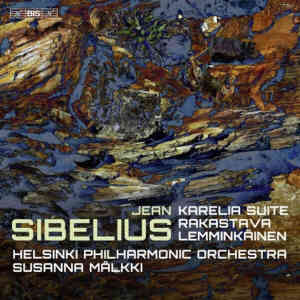
Sibelius: Lemminkäinen Suite, Karelia Suite, Rakastava, Helsinki Philharmonic Orchestra, Susanna Mälkki/BIS

Having recently completed a highly acclaimed series of recordings featuring works by Béla Bartók for the prestigious BIS label, Susanna Mälkki and the Helsinki Philharmonic Orchestra shift their focus closer to home with a generous and beautifully recorded SACD, showcasing a selection of early orchestral works by Jean Sibelius. In this 78-minute musical journey, Mälkki’s prowess as a conductor shines through, elevating these well-known pieces to new heights. Despite the abundance of recordings for the featured compositions, Mälkki’s interpretations are always worth exploring, as is evident in this captivating collection. The opening performance of the popular Karelia Suite sets the tone with Mälkki’s poised and nuanced direction, highlighting the exceptional quality of musicianship within the Helsinki Philharmonic Orchestra. The delicate and tender rendition of ‘Rakastava’ (The Lover), in its familiar arrangement for strings with added triangle and timpani in the outer movements, demonstrates Mälkki’s careful shaping of this exquisite work, and though ‘Rakastava’ is the only work on this SACD to be recorded at public concerts there is no trace of the presence of an audience to disturb the rapt atmosphere created by Mälkki and her responsive Helsinki musicians. Moving on to Sibelius’s Lemminkäinen legends Op.22, Mälkki guides us through these symphonic poems with finesse. The first legend, ‘Lemminkäinen and the Maidens of the Island,’ unfolds vividly with carefully measured pacing, capturing both the sensuousness and drama inherent in the music. In ‘The Swan of Tuonela,’ the cor anglais of Paula Malmivaara and the unnamed cello soloist shine. They are skilfully balanced within the orchestral texture and the avoidance of any spotlighting adds depth to this evocative piece.
Arguably the greatest challenge for conductors is the brooding ‘Lemminkäinen in Tuonela,’ yet Mälkki navigates its atmospheric complexities with confidence, while the final piece, ‘Lemminkäinen’s Return’ is as thrilling as any on disc. The BIS 5.0 multi-channel recording, crafted in the Helsinki Music Centre by the experienced recording team of producer Robert Suff and recording engineer Enno Mäemets, is a testament to the label’s commitment to excellence, delivering crisp, spacious, and finely detailed sound. As of December 2021, Susanna Mälkki’s announcement of stepping down as the chief conductor of the Helsinki Philharmonic Orchestra by the end of the 2022-2023 season adds a bittersweet note to this recording. However, with Mälkki now serving as the chief conductor emeritus, one can only hope for more outstanding recordings from her in the future. In conclusion, Susanna Mälkki’s latest collaboration with the Helsinki Philharmonic Orchestra is a testament to her interpretative skill and the orchestra’s exceptional musicianship, making this SACD a must-listen for both seasoned enthusiasts and newcomers to Sibelius’s orchestral repertoire.

Surround Sound Sibelius from Chandos

SIBELIUS: VIOLIN CONCERTO AND OTHER WORKS FOR VIOLIN AND ORCHESTRA, James Ehnes, Bergen Philharmonic Orchestra, Edward Gardner/Chandos

It’s always a pleasure to be reminded of the surround sound facilities accorded their artists by the Chandos label. This new disc of Sibelius’ violin concerto and other works for violin and orchestra affords the ear absolute pleasure, with every nuance of the composer’s exquisite orchestration captured in the most acute fidelity. The Concerto is given a remarkable performance by James Ehnes and the Bergen Philharmonic Orchestra under Edward Gardner, and if the other pieces on the disc are very much slighter Sibelius, it’s still a highly attractive disc.

New from Chandos & BIS

FUCHS: ORCHESTRAL WORKS; LIGHT YEAR, etc. Sinfonia of London, John Wilson/Chandos

The second volume in this Chandos series devoted to the orchestral music of the contemporary American composer Kenneth Fuchs (b.1956) proves to be as enjoyable as the first, and those attuned to Fuchs’ instantly accessible body of work will be entranced once more by the variety on offer here. This immaculately recorded SACD opens with a performance of ‘Light year’ (2022-2024), a six movement suite for orchestra after six paintings by Helen Frankenthaler. It was composed shortly after the completion of ‘Cloud Slant’ the main work on the first Volume of this series that I reviewed in July 2023. While audibly similar to its predecessor in style and use of the orchestra ‘Light Year’ is more ambitious in both range and expression, taking the form of an orchestral suite each movement of which is inspired by one of the series of canvases which Frankenthaler painted between 1977 and 1990, and coalesce under the umbrella of stargazing. As the composer has written in the score ‘the music is, like the painting, intended to depict the experience of looking up in wonder at the night time sky full of stars’. The titles of the six movements are ‘Star Gazing’, ‘Stella Polaris’, ‘Lunar Valley’, ‘Hot Ice’, ‘Constellation’ and ‘Light Year’ that may perhaps provide an indication of the composer’s febrile imagination and his characteristic iridescent orchestral textures on display here. As one might expect, John Wilson and his Sinfonia of London revel in the opportunities provided by the composer to project both the diversity and subtleties of Fuchs’ score to the receptive listener, aided of course by the superfine clarity of the Chandos recording.
Fuchs’ ingenious craftsmanship is further epitomized by the two contrasting concertos that follow. ‘Eventide’ is a concerto for Alto Saxophone and an orchestra of percussion, harp, celesta and strings. Originally written for the cor anglais in 2003 it was reworked for the alto saxophone twenty years later. As the title suggests, it is a predominantly pastoral work whose lyricism benefits from the marvellously fluent and sensitive account given here by the superb soloist Timothy McAllister.
Concertos for Bass Trombone are understandably thin on the ground, but this 2018 composition from Kenneth Fuchs will make a welcome addition to this instrument’s limited repertoire. It is an exuberant piece in a single movement, though in four clearly defined sections, that pits the bass trombone against the dazzling colours of Fuchs’ orchestral tapestry and is performed with considerable panache by the young British bass trombonist James Buckle.
For ‘Point of Tranquillity’, the final work on the disc, Fuchs’ inspiration stems from another painting. This time it is one from a contemporary of Helen Frankenthaler – Morris Louis (1912-1962). In this work Fuchs has aspired to match in musical terms the artist’s use of ‘vivid colour washes’ and ‘sense of structural freedom’. Though originally a work for wind band it was adapted for orchestra at the request of the conductor JoAnn Falletta, a long time champion of this composer’s music and it is this latter version performed on this disc.It is a haunting and melodic piece that flows with untroubled serenity, though interspersed by Fuchs’ characteristic splashes of colour and, as with all the works on this compelling disc, it receives a masterly and sympathetic reading from John Wilson and his accomplished players.
Highly recommended.

MAHLER: SYMPHONY NO. 3, Minnesota Orchestra, Osmo Vänskä, BIS SACD


With this release Osmo Vänskä and the Minnesota orchestra complete their epic project to record all ten Mahler symphonies for the BIS label. The journey began in June 2016 with Mahler’s 5th Symphony and continued with the 6th Symphony in November of the same year. A further five symphonies were recorded in subsequent years before the COVID-19 Pandemic threatened to derail the rest of the cycle. Fortunately, after three years, the recording sessions resumed with the 9th and 8th Symphonies – the latter being the final work performed and recorded by Vänskä before the end of his 19-year tenure as the orchestra’s Music Director. In his new role as Conductor Laureate he returned in November 2020 to complete the ‘Mahler Project’ with this resplendent account of the 3rd Symphony, certainly the composer’s longest and in many respects most challenging composition for a conductor.
With a playing time of a little over 103 minutes Vänskä’s performance is marginally more spacious than a number of the other dozen recordings of the work available in high resolution sound, but its expansiveness is only really evident in the vast opening movement (35’52) where the conductor’s pacing allows each of the movement’s diverse and often wild sections to make their maximum impact (one such example being the huge glissandos he elicits in the brass from 4’24) without losing his grip on the overall structure. The magnificent playing of the Minnesota Orchestra, a major factor and a constant pleasure in each and every release in this Mahler cycle, is showcased again here. From the stentorian opening fanfare, delivered with supreme confidence by the Minnesota horns, to the eloquent trombone solos from R. Douglas Wright and the tumultuous closing pages of Part I (marked ‘mit höchster Kraft’) Vänskä’s players give their all.
The ‘Tempo di Menuetto ‘that opens Part II (originally titled ‘What the Flowers in the Meadow Tell Me’) is played with appropriate lightness and grace; Vänskä’s uncontroversial pacing allowing full appreciation of the superfine musicianship on display, especially from the woodwind. The characterful and occasionally sinister ‘Comodo. Scherzando’ that follows features an off-stage Dotzauer Fürst Pless Rotor 18915 valved posthorn in B flat (pictured in the booklet) appropriately distanced in the recording and expertly played by Manny Laureano whose trumpet playing excels throughout the Symphony.
The Nietzsche setting that comprises the 4th movement is sung movingly by Jennifer Johnston while the clear and well projected voices of the Minnesota Boyschoir and the women of the Minnesota Chorale bring appealing simplicity to the childlike Wunderhorn poem that follows.
It comes as no surprise that Vänskä’s unforced rendition of the finale puts the ultimate seal of quality on this performance. The Minnesota strings play with exquisite refinement as the music travels from opening serenity to the tonal intensity of the overwhelming final bars. In short, Vänskä’s reading has a magisterial grandeur and impressive focus that places it among the finest versions of this much recorded symphony.
Even taking for granted the usual high standards we have come to expect from BIS, the recording team of Vänskä’s long-time collaborators – producer Robert Suff and recording engineer Marion Schwebel – have excelled themselves here. The soundstage on these two 5.0 multi-channel SACDs is both wide and deep with an expertly judged balance between low level percussion detail and thunderous climaxes within the generous ambience of Orchestra Hall, Minneapolis.
This outstanding recording makes a fitting conclusion to Vänskä’s individual and sometimes controversial Mahler cycle

Britten in Surround Sound

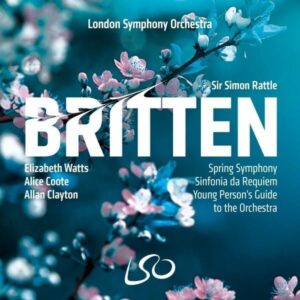
The music of Benjamin Britten has a been central feature in Simon Rattle’s repertoire since he was a teenager and his authoritative performances both in the Concert Hall and on disc have been widely praised. On this generous filled (79’31”) SACD from LSO Live he revisits two of the composer’s most popular orchestral works that he recorded for EMI with the City of Birmingham Symphony Orchestra back in the 1980s – The ‘Sinfonia da Requiem’ and the ‘The Young Person’s Guide to the Orchestra’ also known as ‘Variations and Fugue on a Theme of Purcell’. The disc also includes Britten’s rarely performed ‘Spring Symphony’ Op. 44
.
Rattle’s most recent account of the ‘Sinfonia da Requiem’– recorded live in the Barbican 7th to 8th of May 2019 – benefits not only from the considerable virtuosity of the LSO’s playing but also the conductor’s more taut approach to the score than on his earlier recording. The opening ‘Lacrymosa’(marked Andante ben misurato) proceeds from its terrifying drum thwacks with implacable power and leads into a fast and superbly articulated ’Dies Irae’. Rattle’s handling of the music’s disintegration after its final climax is immaculate and leads seamlessly into a Mahlerian ‘Requiem aeternam’ that is poignant, but taken by the conductor at a pace that eschews any gratuitous sentimentality.

Britten’s ‘Spring Symphony’, here making its first appearance in high resolution sound, was a commission from the Koussevitsky Music Foundation in1947, but was not completed until two years later. Arguments as to whether this work is a true symphony or an extended song cycle for large forces on the subject of its title may rage, but there can be little doubt that Rattle’s commanding account of this complex score could hardly be improved upon. He has assembled a first rate team of soloists for his rendition led by the excellent tenor Alan Clayton (an outstanding Peter Grimes), mezzo-soprano Alice Coote and soprano Elizabeth Watts while the various Tiffin Schools’ choirs and the London Symphony Chorus acquit themselves with considerable distinction.

Britten uses his large orchestral forces that includes triple woodwind, four percussionists and two harps with restraint rarely involving the entire orchestra. The spare orchestral textures of the Introduction ‘Shine out, fair sun’ that perfectly evoke the icy chill of winter are captured with clarity by the recording and as the work proceeds it is clear that the Classic Sound engineers have done a splendid job ensuring that every detail of Britten’s unconventional scoring can be perceived by the listener.

The excellent liner notes provide a detailed guide to the Symphony as well as the English texts fastidiously chosen by Britten that, W H Auden apart, are taken predominantly from anthologies of 16th and 17th verse.

The ‘Young Person’s Guide to the Orchestra’ of 1945, arguably Britten’s most popular orchestral work needs no introduction. Rattle’s incisive and polished account of this score is in the same league as the composer’s 1964 recording with this same orchestra and completes this most satisfying programme in fine style.

An unqualified recommendation is warranted.

Noseda’s Beethoven, Maalki’s Sibelius

BEETHOVEN: THE COMPLETE SYMPHONIES, National Symphony Orchestra, Gianandrea Noseda/NSO  In 2005 the BBC Philharmonic, led by Gianandrea Noseda, created quite a buzz with their live recordings of Beethoven symphonies, garnering 1.4 million download requests. Fast forward 16 years, and Noseda, now in his seventh season as the Music Director of the National Symphony Orchestra in Washington DC, revisits these timeless masterpieces in a thrilling new cycle. Noseda’s philosophy on Beethoven is unequivocal: “Beethoven’s voice is as fresh and powerful today as it was when he created those masterpieces. To approach Beethoven is a journey. You know you are starting the journey, but you never know where the journey will take you. With Beethoven any moment is a discovery.” This journey, as reflected in these performances, is undoubtedly a brisk one. Noseda adopts fast speeds across all nine symphonies, often aligning with Beethoven’s disputed metronome markings. However, the boundless energy and rhythmic incisiveness with which these renditions are delivered will be embraced by many listeners. Noseda wisely retains all repeats, but opts not to divide his violins antiphonally, thus deviating from period practices. Yet, the quicksilver speeds and the use of hard sticks on timpani provide a nod to historical interpretations. While moments of repose in slow movements are scarce, the overall impact is compelling. A notable strength of these performances lies in their avoidance of interpretive mannerisms that plague some recordings. Noseda lets the music speak for itself within his defined parameters while the National Symphony Orchestra, especially the woodwind and horn sections, earns praise for both the elegance of their playing and their fearless execution. In the finale of the Ninth Symphony the large, and clearly well-trained, Washington Chorus impresses with its forceful delivery and fine diction. Among the soloists bass-baritone Ryan McKinny and tenor Issachah Savage stand out for their fervent and powerful singing, while Camilla Tilling and Kelley O’Connor seem somewhat overshadowed. Recorded live between January 2022 and June 2023 at the John F. Kennedy Centre for the Performing Arts, these performances are captured on five SACDs. Thanks to the efforts of the Soundmirror engineering team the sound quality is immediate and crisply focused throughout the cycle with a notably strong reproduction of the bass end of the spectrum. Although any traces of an audience are absent, unfortunately the conductor’s audible exhalations and exhortations, particularly in the 4th and 5th Symphonies, remain and could become more than a slight irritation on repeated listening. The remaining two discs, presented on Pure Audio Blu-ray, offer multiple audio streams (5.0 DTS-HD MA 24bit / 192 kHZ, 2.0DTS-HD MA 24bit / 192 kHZ, and Dolby Atmos ). Disc 6 holds Symphonies 1-6, while Disc 7 features the remaining three symphonies in addition to a high-definition filmed performance of the Ninth Symphony from the 3rd of June 2023, showcasing Noseda’s considerable dynamism on the podium. Each of the discs in this set are most attractively presented in sleeves illustrated by artist Mo Willems (Artist-in-Residence at the Kennedy Centre) whose striking and colourful abstractions – one for each of the nine symphonies – are reproduced in the lavish accompanying booklet. This set makes a valuable addition to the ever burgeoning recordings of Beethoven Symphonies in high-resolution sound on disc, and while not necessarily supplanting other cycles will certainly join them as a solid recommendation to prospective purchasers.

SIBELIUS: KARELIA SUITE, RAKASTAVA, LEMMINKAINEN, Helsinki Philharmonic Orchestra, Susanna Malkki/BIS Having recently completed a highly acclaimed series of recordings featuring works by Béla Bartók for the prestigious BIS label, Susanna Mälkki and the Helsinki Philharmonic Orchestra shift their focus closer to home with a generous and beautifully recorded SACD, showcasing a selection of early orchestral works by Jean Sibelius. In this 78-minute musical journey, Mälkki’s prowess as a conductor shines through, elevating these well-known pieces to new heights. Despite the abundance of recordings for the featured compositions, Mälkki’s interpretations are always worth exploring, as is evident in this captivating collection. The opening performance of the popular Karelia Suite sets the tone with Mälkki’s poised and nuanced direction, highlighting the exceptional quality of musicianship within the Helsinki Philharmonic Orchestra. The delicate and tender rendition of ‘Rakastava’ (The Lover), in its familiar arrangement for strings with added triangle and timpani in the outer movements, demonstrates Mälkki’s careful shaping of this exquisite work, and though ‘Rakastava’ is the only work on this SACD to be recorded at public concerts there is no trace of the presence of an audience to disturb the rapt atmosphere created by Mälkki and her responsive Helsinki musicians. Moving on to Sibelius’s Lemminkäinen legends Op.22, Mälkki guides us through these symphonic poems with finesse. The first legend, ‘Lemminkäinen and the Maidens of the Island,’ unfolds vividly with carefully measured pacing, capturing both the sensuousness and drama inherent in the music. In ‘The Swan of Tuonela,’ the cor anglais of Paula Malmivaara and the unnamed cello soloist shine. They are skilfully balanced within the orchestral texture and the avoidance of any spotlighting adds depth to this evocative piece. Arguably the greatest challenge for conductors is the brooding ‘Lemminkäinen in Tuonela,’ yet Mälkki navigates its atmospheric complexities with confidence, while the final piece, ‘Lemminkäinen’s Return’ is as thrilling as any on disc. The BIS 5.0 multi-channel recording, crafted in the Helsinki Music Centre by the experienced recording team of producer Robert Suff and recording engineer Enno Mäemets, is a testament to the label’s commitment to excellence, delivering crisp, spacious, and finely detailed sound. As of December 2021, Susanna Mälkki’s announcement of stepping down as the chief conductor of the Helsinki Philharmonic Orchestra by the end of the 2022-2023 season added a bittersweet note to this recording. However, with Mälkki now serving as the chief conductor emeritus, one can only hope for more outstanding recordings from her in the future. In conclusion, Susanna Mälkki’s latest collaboration with the Helsinki Philharmonic Orchestra is a testament to her interpretative skill and the orchestra’s exceptional musicianship, making this SACD a must-listen for both seasoned enthusiasts and newcomers to Sibelius’s orchestral repertoire

First-rate Stravinsky from Chandos


STRAVINSKY: VIOLIN CONCERTO, ETC. James Ehnes, BBC Philharmonic, Sir Andrew Davis/Chandos The highlight of this first-rate all-Stravinsky SACD from Sir Andrew Davis and the BBC Philharmonic is James Ehnes’s account of the composer’s Violin Concerto. The concerto was composed between 1931 and 1932, having been commissioned by the violinist Samuel Dushkin with whom Stravinsky collaborated closely during the composition process, and the work is notable for its neoclassical style, a characteristic feature of Stravinsky’s work during that period. As one might expect from a thoughtful violinist like Ehnes, his performance offers much more than mere virtuosic display in the rhythmically complex ‘Toccata’ that opens the concerto and the ‘Capriccio’ with which it ends. In both of the central ‘Aria’ movements Ehnes stresses the lyricism of the music though never at the expensive of forward momentum. Davis and the BBC Philharmonic provide an accompaniment that is meticulous in observing the many dynamic and tempo changes in all four movements and the combination of the soloist’s peerless technique and the conductor’s eloquent and flexible approach to the score makes for a most refreshing account of the work. The Violin Concerto is followed by a crisply played account of ‘Scherzo à la russe’, composed in the early 1940s for the Paul Whiteman band and later arranged for symphony orchestra, but one that to these ears doesn’t quite have the jazzy swagger of Antal Dorati’s classic Mercury recording. The two ‘Suites for Small Orchestra’ arranged from piano duets Stravinsky had written in the 1910s may be somewhat inconsequential within the composer’s oeuvre, but these pristine performances from Davis show them in the best possible light. The final work on this disc is the ballet ‘Apollon musagète’ (1928, revised 1947) that in keeping with the composer’s emerging neoclassical style is scored for just a string orchestra. Davis and the ravishing BBC Philharmonic strings skilfully capture the ballet’s classical poise and elegance aided by the clarity of the Chandos recording. Although there are a number of excellent recordings of this work available on SACD. to which this one may be confidently added, in the final analysis the alternative couplings will probably be the determining factor for most listeners. The sound of this album, recorded in February 2023 at MediaCityUK, Salford, is warm, detailed and expertly balanced by Sound engineer Stephen Rinker making this a very recommendable release.

Blazing Mahler 8 from Vänskä & BIS

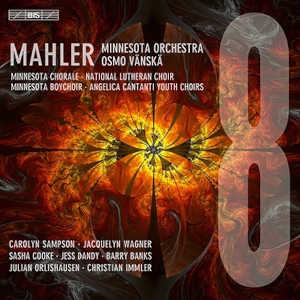
MAHLER: SYMPHONY NO. 8, Minnesota Orchestra, Osmo Vänskä/BIS SACD  Osmo Vänskä and the Minnesota Orchestra cap off their monumental endeavour to record all 10 Mahler Symphonies for BIS with a triumphant performance in this penultimate release. The project, initiated seven years ago with the composer’s Fifth Symphony, marks Vänskä’s final act as the orchestra’s music director after a remarkable 19-year tenure, transitioning to his new role as conductor laureate last year. Throughout his leadership, Vänskä has consistently cultivated a responsive orchestra, delivering superlative musicianship in sync. with his particular interpretive vision. The distinctive two-movement structure of Mahler’s 8th Symphony is artfully navigated in this recording. Part 1, drawing from the medieval Whitsuntide hymn ‘Veni creator spiritus’,unfolds with visceral excitement under Vänskä’s direction. From the commanding E flat chord on the organ and the incisive entry of the massed choirs, he steers his forces with clarity and absolute control throughout this movement to its blazing peroration. In the extended second section, a setting of the final scene of Goethe’s Faust Part II, Vänskä adopts a less frenetic pace while still maintaining a firm forward pulse. Unlike on some other recordings, the vocal ensemble assembled here leaves no room for disappointment. Carolyn Sampson who was engaged to sing Mater Gloriosa rescued the public performance and this recording by agreeing to sing not only her part but also that of Soprano 1 / Magna Peccatrix when the soloist originally booked for the part contracted Covid. Sampson sings radiantly and is complemented by the resplendent voice of soprano Jacquelyn Wagner and the luscious vocal quality of contralto Jess Dandy. One of the pitfalls in Mahler’s 8th Symphony is often the quality of the tenor portraying Doctor Marianus. Not a problem here for Barry Banks, a familiar presence in this work, who handles the role with bright and plangent tenor tones, displaying both sensitivity and musicality. Baritone Julian Orlishausen and bass-baritone Christian Immler contribute their solos with firmness and beauty of tone. The BIS 5.0 multi-channel recording is simply awesome. Producer Robert Suff (a long time collaborator with Osmo Vänskä) and engineer Thore Brinkmann have achieved the almost impossible task of successfully balancing the huge orchestral forces, organ, two mixed choirs, boys choir and seven soloists that allows the full magisterial grandeur and thrusting dynamism of Vänskä’s performance in Part 1 and the closing section of Part 2 to be captured with stunning realism. In the more reflective sections in Part 2 the enunciation of the texts from both soloists and choirs has remarkable clarity. It is also worth mentioning that an extra thrill is in store for those listening on a surround sound system as Mahler’s extra brass emerge with stunning impact from the rear speakers in the closing bars of both Parts. In every aspect, this is an impressive achievement, whetting the appetite for the project’s completion with the release of the Third Symphony in the spring of 2024.

Remarkable Bach from Podger & Channel Classics

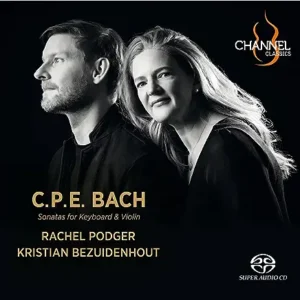
CPE BACH: VIOLIN SONATAS, Rachel Podger, Kristian ezuidenhout/Channel Classics   Rachel Podger solidifies her esteemed standing in the realm of baroque violinists with a remarkable rendition of CPE Bach’s Sonatas, accompanied by the equally accomplished South African keyboard virtuoso, Kristian Bezuidenhout.

The 18th century witnessed a gradual evolution from the Baroque to the Classical era in music. Among the era’s influential and gifted composers, Carl Philipp Emanuel Bach (1714-1788), the second eldest son of Johann Sebastian Bach, held a prominent position. His reputation soared in his time, and his works, including these sonatas, exemplify a bridge between the Baroque and subsequent styles. The first item on this SACD collection is the ‘Harpsichord and Violin Sonata in G minor, H. 542.5’, a piece attributed to both C.P.E. and J.S. Bach, suggesting a potential collaboration between father and son. This composition, along with the four-movement ‘Sonata in D major Wq.71’, features the resounding tones of a copy of a French double manual harpsichord built by Keith Hill, paired with Podger’s signature Pesarinius violin from Genoa, dating back to 1739. Presenting the remaining two sonatas, originating from a set penned in 1763, skilfully demonstrates the composer’s inventive prowess. The captivatingly expressive ‘Adagio ma non troppo’ of the ‘C minor Sonata Wq. 78’, and its quicksilver ‘Presto’ finale are irresistible, while the equally charming ‘Sonata in B minor Wq. 76’ showcases Bezuidenhout’s mastery of a finely crafted fortepiano, meticulously modelled after an Anton Walter instrument by Paul McNulty in 2008. In the ‘Arioso con variazioni Wq.79’ the violin plays a subservient role, enhancing and enriching Bezuidenhout’s eloquent and deeply nuanced performance of the piece’s five variations. A captivating synergy between Rachel Podger and Kristian Bezuidenhout radiates throughout this recital, breathing life into every bar of these sonatas, making it challenging to envisage more exceptional interpretations. The SACD recording, produced in the resonant acoustics of St John the Evangelist in Upper Norwood, London in May 2022, attains sonic perfection. The impeccable engineering of Jared Sacks, renowned for its remarkable realism, captures both artists in harmonious equilibrium, epitomizing the standard of excellence we’ve come to anticipate from his productions. Complementing this outstanding release are authoritative liner notes by Professor Timothy Jones that contribute to the comprehensive allure of this offering from Channel Classics


Superbly Engineered Mahler 9 from BIS

MAHLER: SYMPHONY NO. 9, Minnesota Orchestra, Osmo Vänskä/BIS The performance on this superbly engineered SACD is the latest release in the Minnesota Orchestra’s Mahler Recording Project that began in 2017 with the aim to record all ten Mahler symphonies with their former Music Director Osmo Vänskä. With Symphonies 3 and 8 still to be released this is the last purely instrumental work in the series and arguably the most challenging for any interpreter. In his thoughtful and scholarly liner notes Jeremy Barham posits that though the generally accepted view of the symphony as simply the composer’s ‘farewell to life’ has some credence, much more is represented in the course of its four movements than simply a musical manifestation of loss or grief. Much of Vänskä’s account of the score would seem to chime with Barham’s view. The conductor’s avoidance of overwrought emotion, sometimes verging on hysteria, found in some versions on disc will be welcomed by many while others may feel short changed by the relative austerity of this performance. From the opening bars, with strings, horns and harp in perfect perspective, it is clear that precision and clarity are to be the cornerstones of Vänskä’s interpretation; the antiphonal placing of the violins being one essential part of the latter.The ‘Andante comodo’ (27’57) flows with an inexorable purpose with the conductor building the climaxes with considerable intensity while allowing the marvellous Minnesota players appropriate flexibility in the many chamber-music like sections in this movement. Thanks to Vänskä’s keen rhythmic sense and iron control the second movement (16’35) is most successful, with incisive orchestral playing and the conductor’s firm grip of the movement’s structure. The irony in the music is never overplayed nor is its often grotesque humour. The energy and defiance that Mahler asks for in the Rondo-burleske (12’25) certainly tests the orchestra’s virtuosity to the limit yet they meet its challenges with flying colours. The crispness and accuracy of the playing in the faster passages is astonishing while in the trio section marked ‘Etwas gehalten. Mit grosser Empfindung’ [Held back a little. With great feeling] the dreamy trumpet tune is performed with heartbreaking poignancy. In the Finale (23’39) the conductor’s relative objectivity, evinced throughout the symphony, pays dividends. Any sense of maudlin or sickly sentimentality is absent, and the stoicism of his account brings to mind Otto Klemperer’s memorable description of the music as ‘imbued with the majesty of death’.The richness of the Minnesota strings and superb horns are cathartic in the main body of the ‘Adagio’ and, as one might expect from Vänskä, breathtaking pianissimos hold one spellbound in the fragmentary final pages of the work. With a cornucopia of fine recordings of Mahler’s 9th Symphony available in all formats, collectors have enviable choices to make, but those who seek a state-of-the art recording and are in tune with the style of Vänskä’s compelling interpretations need not hesitate.