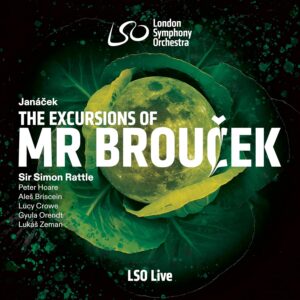
Janáček’s ‘The Excursions of Mr Brouček’ from Rattle and the LSO

Leoš Janáček’s ‘The Excursions of Mr Brouček’ may be one of the composer’s least frequently staged mature operas, but this concert performance by the London Symphony Orchestra under Sir Simon Rattle, recorded live at the Barbican Hall on 4 and 6 May 2025, makes a compelling case for its musical riches. With a superb cast, an outstanding contribution from the Tenebrae Choir and an orchestra playing with remarkable clarity, colour and vitality, this is a performance that reveals just how astonishingly inventive Janáček’s score is.

Rattle’s particularly strong affinity with the composer is already well established from the previous releases in his Janáček opera cycle with the LSO, and his interpretation here is distinguished by both clarity and an exceptional ear for orchestral colour. The score’s restless rhythms, abrupt juxtapositions and sharply etched instrumental gestures are handled with precision but never rigidity. Rather than allowing its episodic structure to become disjointed, Rattle finds ways of giving the music an underlying unity. The result is a performance of considerable refinement in which every detail seems to have its place.

The LSO respond magnificently. From the technically demanding opening, the orchestra displays an extraordinary degree of transparency on this recording. The strings are clear and incisive, while the brass has both brilliance and weight. Janáček’s orchestration is packed with sudden contrasts and unexpected combinations, and Rattle seems determined to reveal every one of them.

At its centre is Peter Hoare’s outstanding portrayal of Mr Brouček. This is a demanding role, both vocally and theatrically, and Hoare inhabits it with tremendous energy. His performance captures the character’s absurdity and pomposity without reducing him to a caricature. Vocally, Hoare is consistently impressive, negotiating Janáček’s speech-inflected writing with clarity, flexibility and stamina.

Aleš Briscein brings a bright, penetrating tenor to Mazal, with an upper register that remained strong and secure. Lucy Crowe is equally impressive, moving between her several roles with remarkable vocal versatility. Her silvery soprano is ideally suited to the music, combining radiance with an expressive warmth that makes her contribution particularly memorable.

The demands on the excellent supporting cast, in which almost everyone changes roles, are considerable, yet the ensemble maintains impressive cohesion throughout. The accurate placement of the singers across the soundstage on this recording makes identifying who is singing considerably easier.

Tenebrae, directed by Nigel Short, is another major asset. The choral writing is delivered with precision and tonal focus that few opera house choruses could achieve, while the male voices make a particularly strong impact when Janáček expands the musical scale. The change in character required later in the work is achieved with impressive stylistic control, and the recording captures the chorus with sufficient presence to give its contributions real weight without overwhelming the soloists.

LSO Live’s presentation is first class. A lavish 160-page booklet includes artist biographies, photographs from the performances, programme notes and a helpful synopsis of the opera from Nigel Simeone but, most importantly, a full Czech/English libretto.

The performance demonstrates that beneath the opera’s eccentricities lies a score of extraordinary originality. In Rattle’s hands, and with an orchestra of the LSO’s calibre, Janáček’s music emerges as vivid, sophisticated and irresistibly alive.

In every respect, this is a cherishable recording.
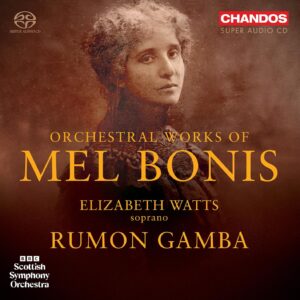


Mel Bonis: Orchestral Works from Chandos

MEL BONIS Orchestral Works, Elizabeth Watts, BBC Scottish Symphony Orchestra, Rumon Gamba/Chandos SACD 

Mel Bonis (1858–1937), a name few of us will have encountered, remains one of the most compelling rediscoveries in French music. Born Mélanie Bonis, she adopted a gender-neutral pseudonym to navigate a musical world dominated by men. Despite studying at the Paris Conservatoire alongside Debussy and Pierné, her career was constrained by social expectations and personal circumstances. Her music, however, speaks with a distinctive and confident voice – lyrical and richly imaginative. Bonis composed across a wide range of genres, from piano miniatures to chamber and orchestral works, often blending Romantic warmth with subtle harmonic innovation. For much of her life, recognition eluded her, not least because of the barriers faced by women composers of her era. Yet her work reveals a composer of striking individuality and emotional depth. Today, at least on disc, her music is finally gaining the attention it deserves, offering a vivid testament to a talent that persisted against the odds.

This new SACD from Rumon Gamba and the BBC Scottish Symphony Orchestra presents a welcome survey of Bonis’s relatively small orchestral output, composed between 1891 and 1912. It is a programme that not only highlights her skill as an orchestrator but also reveals a composer attuned to colour, character, and narrative suggestion.

The centrepiece of the disc is the ‘Trois Femmes de Légende’(1909), a symphonic suite depicting Ophélie, Salomé and Cléopâtre. At just under eighteen minutes, it is the most substantial work here and offers the clearest demonstration of Bonis’s orchestral prowess. Each movement is vividly characterised, with finely judged orchestral textures and a strong sense of atmosphere; Bonis proves adept at evoking psychological nuance through colour and gesture rather than overt drama. The two delightful orchestral songs – ‘Le Chat sur le toit’ and ‘Noël de la Vierge Marie’ – are entrusted to the beguiling voice of Elizabeth Watts who delivers them with sensitivity and pure tone.

Much of the remaining programme is built around dance-inspired works, including the ‘Suite en forme de valses’ and ‘Danse sacrée’ (1898), two movements from the ‘Suite orientale’ (1900), and the ‘Trois Danses’ (1904 –1909). While these pieces may not always leave a lasting thematic imprint, they are consistently well crafted, melodically appealing, and orchestrated with finesse. Bonis’s gift lies less in bold structural innovation than in her ability to sustain mood and charm through subtle harmonic inflection and elegant scoring.

The disc concludes with ‘Les Gitanos’ (1891), a Spanish waltz that proves to be something of a showpiece. Here, both composer and performers seem especially energised, the music bursting with rhythmic vitality and colour. It makes for a rousing and memorable conclusion, and one can easily imagine it serving as an effective concert encore.

Throughout, Rumon Gamba and the BBC Scottish Symphony Orchestra prove persuasive advocates for this repertoire. The playing is polished and responsive, with a clear commitment to bringing out the music’s detail and character. The recording, made in Glasgow’s City Halls, a venue whose acoustic has often positively enhanced many of the finest Chandos productions is of a high standard, offering a satisfying blend of warmth and clarity that allows the orchestral textures to register fully. Informative and authoritative booklet notes by Nigel Simeone further enhance this release, providing valuable context for the listener. To sum up, this is an admirable and highly enjoyable recording that makes a strong case for Mel Bonis’s orchestral music. Beautifully performed and expertly recorded, it stands as an important contribution to the growing discography of a composer whose voice deserves to be heard.


Debussy Duets from Chandos

DEBUSSY: PIANO DUETS VOLUME 2, Héléne Mercier, Louis Lortie/Chandos

Those who purchased the first Chandos disc of music for two pianos by Debussy will need little persuasion to acquire this delicious follow-up which is (as before) a mélange of music written for this combination of instruments along with subtle and nuanced transcriptions of orchestral Debussy. The musical partnership of Héléne Mercier and Louis Lortie goes beyond mere sympathetic understanding and has become something almost symbiotic. Lovers of the piano and Debussy aficionados should not hesitate

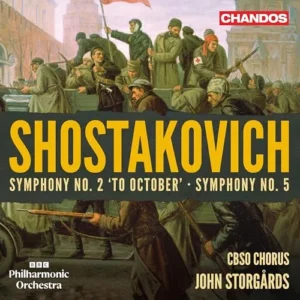
SHOSTAKOVICH 2 & 5 from Storgårds & Chandos

SHOSTAKOVICH SYMPHONIES 2 & 5

BBC Philharmonic, John Storgårds/Chandos

While Shostakovich’s Second Symphony may be unfamiliar to many listeners, it’s hard to imagine the piece given a more persuasive advocacy than it receives here – and the much-recorded Fifth Symphony (with which Shostakovich cleverly dealt with the moronic criticism of the Soviet authorities of the day) is given a performance of blazing intensity in a Chandos recording that does full justice to the orchestration. Both works are dispatched here with an élan that matches their inspiration. It’s encouraging to report that this remarkable sequence of Shostakovich symphonies by John Storgårds remains absolutely top-notch, both in terms of exhilarating performances and the characteristically widespread Chandos surround sound. Over the years, many recordings have done considerable justice to these dynamic masterworks of the modern orchestral repertoire, but for some time, the readings by Storgårds have come to be regarded as truly memorable.

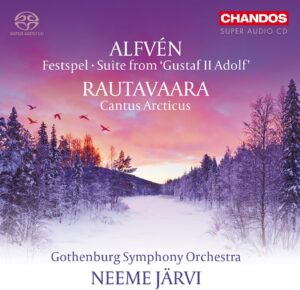
Alfven & Rautavaara: Orchestral Works/Järvi

It is fair to say that, with the possible exception of the first of his three ‘Swedish Rhapsodies’ (Midsommarvaka), the music of the Swedish composer Hugo Alfvén (1872–1960) is not well known outside his homeland. This is most regrettable, as his vividly pictorial orchestral music combines an appealing late-Romantic richness with a strong sense of Swedish identity that I am sure many listeners would enjoy.

The conductor on this SACD, recorded live in the Gothenburg Concert Hall on 11 October 2024, is NeemeThroughout his long and illustrious career, Järvi has been a tireless champion of Alfvén’s oeuvre, and many will recall that in the late 1980s he recorded memorable accounts of the composer’s five symphonies and other orchestral works. The curtain-raiser for this concert is ‘Festspel’ Op. 25, whose thrilling opening fanfares lead to an ebullient polonaise reminiscent of that in Tchaikovsky’s opera ‘Eugene Onegin’. The panache with which Järvi and the Gothenburg Symphony Orchestra perform it certainly belies the maestro’s 87 years.

We move to Finland for the next work, Rautavaara’s atmospheric ‘Cantus arcticus’ (Concerto for Birds and Orchestra), written in 1972 and here making its first appearance on SACD. ‘Cantus arcticus’ is widely regarded as Rautavaara’s most famous and frequently performed work, a status that reflects its originality and accessibility rather than any great structural complexity. Its appeal stems largely from its evocative combination of live orchestra with recorded birdsong, which brings the natural world vividly into the concert hall. In this performance, the sounds of cranes, shore larks, whooper swans, and other birds – realised by Daniel Arnesson and Jan Svanberg – are effectively integrated into the orchestral texture.

The final work on the disc is Alfvén’s ‘Gustav II Adolf’ Suite for Orchestra, Op. 49. It was written to commemorate the 300th anniversary of the death of Gustav II Adolf in connection with a play at the Royal Swedish Opera. While the play itself is long forgotten, Alfvén’s colourful and celebratory music is well worth hearing. The suite consists of eight contrasting movements and, although the orchestral writing is cinematic – at times approaching the brilliance of Richard Strauss – it is generally more conservative harmonically. The GSO and their veteran conductor Emeritus clearly revel in both the lyrical and exuberant sections of this impressive score, whether in the opening ‘Vision’ with its glowing brass, the lively ‘Bourré for three bassoons, the moving ‘Elegi’, or the thrilling depiction of the Battle of Breitenfeld (1631) that concludes the work in heroic style.

The recording (24-bit / 48 kHz), made by producer Lars Nilsson and sound engineer Michael Dahlvid of Nilento Studio, is impressively vivid, though the close miking does slightly limit the sense of concert-hall spaciousness. An unusual feature in the Alfvén Suite is the long pauses between tracks (up to 12 seconds), presumably to allow the audience to settle before the music continues. Any applause or audience noise has been expertly excised throughout.

This is a most enjoyable disc of largely neglected Scandinavian music that, while not without its limitations, offers much to admire and will be of particular interest to those keen to explore beyond the standard orchestral repertoire.


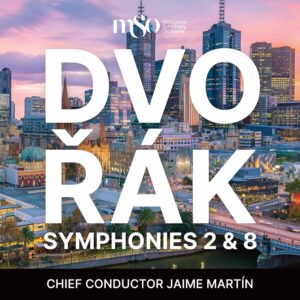
A Warm Welcome for Dvořák from Melbourne

DVORAK: SYMPHONIES 2 & 8, Melbourne Symphony Orchestra, Jaime Martin/ MSO  A warm welcome is warranted for this latest issue from the Melbourne Symphony Orchestra’s own label. This is the second release in the orchestra’s projected cycle of Dvořák’s nine symphonies under their chief conductor Jaime Martín, and it comes on two SACDs for the price of one. The coupling is both intelligent and appealing: one of the composer’s least performed works, the Symphony No. 2 in B-flat major, Op. 4, paired with one of his most popular, the Symphony No. 8 in G major, Op. 88. Dvořák composed his Second Symphony in 1865, when he was just twenty-four and suffering the pangs of romantic rejection from his pupil, the singer Josefina Čermáková. Revised in 1887 to lighten the thick original orchestration, it remains the longest symphony he ever wrote – on this recording it plays for 58 minutes and 18 seconds. While its length and youthful profusion of ideas may have kept it from popularity in the concert hall, there is still much to admire in its sweep and invention. The score is brimful of attractive melodies and rich harmonic colour, its Wagnerian glow at the opening setting the tone for music of unabashed romantic warmth. Although it may not always sustain perfect cohesion or indeed hold the listener’s attention, its many lyrical and dramatic episodes are undeniably engaging. Martín directs a warm and deeply sympathetic performance that makes a strong case for this neglected score. He keeps textures clear and the lines purposeful, ensuring that every phrase breathes naturally. The Melbourne Symphony Orchestra plays with refinement and conviction throughout – strings lithe and radiant, woodwinds characterful, brass noble yet never overbearing. There is a real sense of discovery here, of these musicians relishing the freshness of Dvořák’s youthful imagination and shaping it with maturity and care. The exuberant finale, arguably the strongest of the four movements, is especially thrilling in Martín’s hands and crowns the symphony magnificently. There is, without doubt. an abundance of recommendable versions of the much-loved Eighth Symphony on disc to suit all tastes, but Martín and the MSO deliver a performance that can stand comparison with some of the finest in the catalogue. The poetic opening has an appealing simplicity, while the interplay of wind and strings in the ensuing movements is beautifully balanced. The orchestra captures both the rustic charm and the spontaneous joy that make this work so irresistible, the music buoyant, lyrical, and full of life. Everything feels freshly minted, the phrasing natural, the rhythmic lift infectious. Both symphonies were recorded live at Hamer Hall, Arts Centre Melbourne –No. 2 between 31 March and 5 April 2025, and No. 8 between 25 and 29 June 2024. The recorded sound is first-rate, offering a pleasing balance of warmth, clarity, and natural perspective. The SACD format allows the orchestra’s tonal depth and dynamic range to register fully, and the live setting adds a welcome sense of immediacy without any compromise in polish or precision.

This release is another success for Jaime Martín and the Melbourne Symphony Orchestra. Their combination of insight, energy, and technical finesse, captured in sound of notable quality, makes this a distinguished addition to the Dvořák discography. If the remaining instalments of the cycle maintain this high standard, the MSO’s Dvořák series will surely become one of the most rewarding modern surveys of these symphonies. I look forward

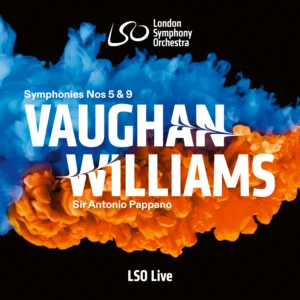
VAUGHAN WILLIAMS: Symphonies 5 & 9 from LSO Live

London Symphony Orchestra, Antonio Pappano/LSO Live

The opening instalment in Sir Antonio Pappano’s projected Vaughan Williams symphony cycle with the London Symphony Orchestra was a coupling of the composer’s Symphonies 4 and 6 that appeared in 2021 and garnered widespread critical praise for the conductor’s thrilling and insightful interpretations of these two works. Four years on, this latest issue couples one of the composer’s most performed symphonies – the 5th premiered in 1943 during World War II – with the 9th regarded by some as “a tough nut to crack”. Pappano’s powerful and totally committed account of the latter recorded live at the Barbican on 15th December 2024 will surely go a long way to convince naysayers that the 84 year old composer had lost any of his inspiration and orchestral mastery. One important feature of the piece is its innovative scoring that includes a flugelhorn, three saxophones and a large percussion section (snare drum, tenor drum, bass drum, cymbals, triangle, tam-tam, deep bells, glockenspiel, xylophone and celesta) used with restraint. Pappano and the LSO pull no punches in delivering this often enigmatic symphony. His purposeful conducting and assured playing from the orchestra, attuned to both the subtle tonal palette and granite like architecture of the piece, ensure the work’s elusive blend of austerity and radiance is delivered with absolute conviction. The Fifth Symphony, drawn from performances on 12 and 14 April 2024, receives a reading of luminous poise and spiritual depth. Pappano stands comfortably in the lineage of such distinguished interpreters as Boult, Previn, and Hickox, matching their authority while bringing a fresh sense of refinement and transparency. Tempi throughout are judiciously chosen, and the orchestra’s glowing tone and finely balanced textures are superbly caught by the Classic Sound team on this SACD in a fine DSD256fs recording. As with recent LSO Live issues, the presentation is exemplary: the disc is housed in a sturdy book-style package complete with full liner notes and artist biographies. This is a release of distinction and a firm recommendation for both seasoned Vaughan Williams admirers and newcomers alike. I look forward to the next release in this cycle.

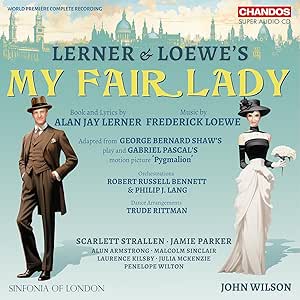
Complete My Fair Lady from Chandos

LERNER & LOWE: MY FAIR LADY soloists, Sinfonia of London, John Wilson/Chandos

When not doing great service to music lovers with its various orchestral issues, the Chandos company appears to have developed a very useful sideline in absolutely complete performances of great musicals, under the expert stewardship of John Wilson, a man who knows his way as well around an MGM score as well as he does a Respighi tone poem. Having delivered excellent new versions of Rodgers and Hammerstein’s Carousel and Oklahoma, the conductor — with the ever-excellent Sinfonia of London — turns his attention to a musical originally mooted for Rodgers and Hammerstein but in the event completed by Lerner and Lowe: the immortal My Fair Lady. With sympathetic soloists such as Scarlett Straalen, the singing could not be in better hands – but the real clincher here is an element also to be found on the Rodgers and Hammerstein sets: the exquisite original arrangement by Robert Russell Bennett. This doyen of the American musical could be said to have created the definitive Broadway sound, and the sprucing up of his reputation under the sympathetic direction of John Wilson could not be more welcome. Another winner for Chandos.

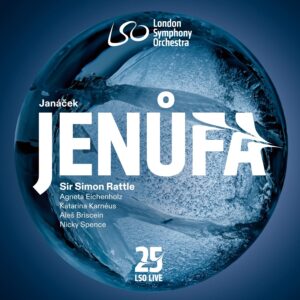
Rattle’s JENŮFA

JANÁČEK: JENŮFA, soloists, London Symphony Orchestra, Simon RATTLE/LSO Live SACD

A powerful cast here includes Agneta Eichenholz’s remarkable performance in the title role – this is a Jenůfa to match any previous sopranos who have tackled the role. This third in a series of Janáček operas presented by Conductor Emeritus Sir Simon Rattle and the LSO maintains the exceptionally high standard of its predecessors, Katya Kabanova and The Cunning Little Vixen, both of which enjoyed considerable acclaim. There may have been a time when people felt that the last word on the great Janacek operas consisted of the splendid Charles Mackerras recordings of the past, but the London Symphony Orchestra under Simon Rattle has demonstrated with élan that other approaches to these operatic masterpieces are feasible. Accorded magnificent sound, this new Rattle recording of Jenufa, one of the composer’s most distinctive pieces, becomes nigh definitive

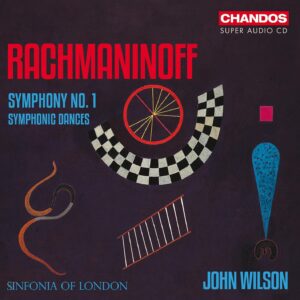
Top-Notch Rachmaninov from John Wilson

RACHMANINOV: SYMPHONY NO. 1, Sinfonia of London, John Wilson/Chandos SACD  With this release John Wilson and his superb Sinfonia of London complete their survey of the three Symphonies and other orchestral works of Rachmaninov for Chandos. The coupling of these two pieces on this SACD is especialy apt, since they span the composer’s creative journey from youthful intensity to mature reflection. Intriguingly, the theme from the final movement of the First Symphony reappears in the ‘Symphonic Dances’, thus linking the two works across decades. Those familiar with John Wilson’s many recordings with the Sinfonia of London will know exactly what to expect from these performances. Orchestral playing of breathtaking precision and bracing verve combined with discipline and outstanding technical security. Wilson’s avowed love of Rachmaninov’s music shines through in both works and, as usual with this conductor, his attention to detail is both meticulous and rewarding for the listener.

Rachmaninov’s First Symphony was written in 1895 when the composer was just 22 years old. However, its first performance in 1897 was a complete disaster. It was badly conducted by Alexander Glazunov and dammed by the critics. When Rachmaninov went into exile in 1917 the score was left in Russia and subsequently lost. In 1944, after the composer’s death, the separate instrumental parts of the symphony were discovered in the Leningrad Conservatory and used to reconstruct the full score. Wilson’s account of this still somewhat neglected work is gripping throughout. From the dramatic opening Wilson carries the musical argument with unerring expertise. Tempi in each of the four movements are felicitous and close to those adopted by Vladimir Ashkenazy on his celebrated (RBCD) recording from 1983 for Decca. Wilson captures the refined melancholy of the Larghetto just as convincingly as the turbulent energy of the finale, complete with its crashing tam-tam strokes. It is, in every respect, a masterly account of this symphony.

Many regard the ‘Symphonic Dances’(1940) as Rachmaninov’s finest orchestral work. Since its premiere by the Philadelphia Orchestra under Eugene Ormandy, it has steadily grown in popularity and has received many fine performances on disc. Wilson emphasizes the work’s rhythmic drive and structural clarity, opting for brisk tempos that heighten excitement and momentum. While this approach does slightly downplay the brooding introspection and nostalgic melancholy of the slower sections, the overall interpretation is undeniably thrilling. The Sinfonia of London responds with blazing virtuosity and infectious energy, particularly in the vitality of the first dance and the menacing grandeur of the finale. It only remains to state, simply for reference, that the final tam-tam stroke in the third dance is curtailed rather than left to resonate into silence as on some other recordings.

Both the Symphony and the ‘Symphonic Dances’ are presented in new editions of the scores; the former by Ed Liebrecht and the latter by Wilson himself. I doubt though that many listeners would detect any differences from what we hear on other performances of these pieces.

The recordings made by the usual expert Chandos team of Ralph Couzens and Brian Pidgeon took place in the Church of St Augustine, Kilburn, London in January and October 2024 and sound on this hybrid multichannel SACD is characteristically excellent – clean, spacious and boasting a wide dynamic range. Those who have enjoyed Wilson’s previous Rachmaninov ecordings will undoubtedly want to add this distinguished release to their collection.