
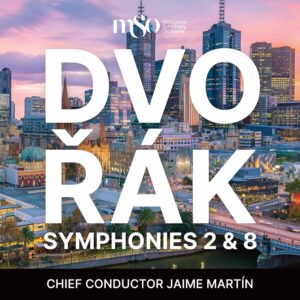
 DVORAK: SYMPHONIES 2 & 8, Melbourne Symphony Orchestra, Jaime Martin/ MSO A warm welcome is warranted for this latest issue from the Melbourne Symphony Orchestra’s own label. This is the second release in the orchestra’s projected cycle of Dvořák’s nine symphonies under their chief conductor Jaime Martín, and it comes on two SACDs for the price of one. The coupling is both intelligent and appealing: one of the composer’s least performed works, the Symphony No. 2 in B-flat major, Op. 4, paired with one of his most popular, the Symphony No. 8 in G major, Op. 88. Dvořák composed his Second Symphony in 1865, when he was just twenty-four and suffering the pangs of romantic rejection from his pupil, the singer Josefina Čermáková. Revised in 1887 to lighten the thick original orchestration, it remains the longest symphony he ever wrote – on this recording it plays for 58 minutes and 18 seconds. While its length and youthful profusion of ideas may have kept it from popularity in the concert hall, there is still much to admire in its sweep and invention. The score is brimful of attractive melodies and rich harmonic colour, its Wagnerian glow at the opening setting the tone for music of unabashed romantic warmth. Although it may not always sustain perfect cohesion or indeed hold the listener’s attention, its many lyrical and dramatic episodes are undeniably engaging. Martín directs a warm and deeply sympathetic performance that makes a strong case for this neglected score. He keeps textures clear and the lines purposeful, ensuring that every phrase breathes naturally. The Melbourne Symphony Orchestra plays with refinement and conviction throughout – strings lithe and radiant, woodwinds characterful, brass noble yet never overbearing. There is a real sense of discovery here, of these musicians relishing the freshness of Dvořák’s youthful imagination and shaping it with maturity and care. The exuberant finale, arguably the strongest of the four movements, is especially thrilling in Martín’s hands and crowns the symphony magnificently. There is, without doubt. an abundance of recommendable versions of the much-loved Eighth Symphony on disc to suit all tastes, but Martín and the MSO deliver a performance that can stand comparison with some of the finest in the catalogue. The poetic opening has an appealing simplicity, while the interplay of wind and strings in the ensuing movements is beautifully balanced. The orchestra captures both the rustic charm and the spontaneous joy that make this work so irresistible, the music buoyant, lyrical, and full of life. Everything feels freshly minted, the phrasing natural, the rhythmic lift infectious. Both symphonies were recorded live at Hamer Hall, Arts Centre Melbourne –No. 2 between 31 March and 5 April 2025, and No. 8 between 25 and 29 June 2024. The recorded sound is first-rate, offering a pleasing balance of warmth, clarity, and natural perspective. The SACD format allows the orchestra’s tonal depth and dynamic range to register fully, and the live setting adds a welcome sense of immediacy without any compromise in polish or precision.
This release is another success for Jaime Martín and the Melbourne Symphony Orchestra. Their combination of insight, energy, and technical finesse, captured in sound of notable quality, makes this a distinguished addition to the Dvořák discography. If the remaining instalments of the cycle maintain this high standard, the MSO’s Dvořák series will surely become one of the most rewarding modern surveys of these symphonies. I look forward