
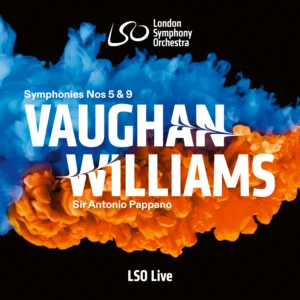
 VAUGHAN WILLIAMS: Symphonies Nos 5 & 9, London Symphony Orchestra, Antonio Pappano/LSO Live
Maestro Antonio Pappano’s highly impressive readings with the London Symphony Orchestra of Vaughan Williams’s fourth and sixth symphonies was an absolute winner, so it’s hardly a surprise that this follow-up disc of the fifth and final Symphonies maintains the upward trajectory of its predecessor. The London Symphony Orchestra, of course, is an aggregation famous for its interpretation of this glorious corpus of work, (in earlier decades, under Previn, a Vaughan Williams set with the orchestra was a market leader), and this new set is proving equally revelatory. The Ninth, with its unorthodox orchestration, has been sometimes a tough nut to crack, but Pappano and the LSO demonstrate that it is the perfect finale to a remarkable set of nine symphonies. Similarly, the Fifth Symphony is here dispatched with great sensitivity and drama.
SHOSTAKOVICH: SYMPHONIES ONE & THREE ‘THE FIRST OF MAY’, SCHERZO OPUS 1, SCHERZO OPUS 7/ BBC Philharmonic, John Storgårds/Chandos
Apart from a highly committed performances given to Shostakovich’s First Symphony – in many ways the composer’s youthful calling card — and the once neglected Third Symphony (which is by no means the Stalinist agitprop piece it was once considered to be), there are two particularly neglected gems here, the Scherzi Opus 1 and 7. These will be unknown to all but the most dedicated Shostakovich enthusiast, and are dispatched here with an élan that matches their nine minutes or so brevity. It’s encouraging to report that this remarkable sequence of Shostakovich symphonies by John Storgårds remains absolutely top-notch, both in terms of exhilarating performances and the characteristic Chandos sound. Over the years, many recordings have done considerable justice to these dynamic masterworks of the modern orchestral repertoire, but for some time, the readings by Storgårds have come to be regarded as authoritative. This is one of the finest ongoing complete set of the Shostakovich symphonies now on the market.
BRAHMS: EIN DEUTSCHES REQUIEM, soloists PSH/Kent Nagano/BIS SACD
Some pieces are particularly lucky on disc, and Brahms’ Ein Deutsches Requiem is such a work. In order to make a mark, any new recording of this choral masterpiece has to offer a persuasive and nuanced performance in impeccable sound, and this latest take from Kent Nagano more than fulfils this requirement – and, what’s more, it’s presented in the kind of richly detailed surround sound picture that the BIS label is famous for.
ROZSA: ORCHESTRAL WORKS: Sinfonia Concertante, etc. Gregor Buhl/Capriccio
This is an immensely enjoyable disc and a reminder – if that were needed – of the composer Miklós Rósza’s skills in the classical field as opposed to his matchless film scores. Aficionados of the music of the multi-talented Hungarian (if they are the enterprising sort) will have tracked down most of the music featured on this CD, nearly all of which has been available at some time or other. But splendid though some of the past performances of these pieces were, the sheer exuberance and command of orchestral colour channelled into these readings is admirable.
BACEWICZ: ORCHESTRAL WORKS, Peter O’Donoghue, piano, BBC Symphony Orchestra, Sakari Oramo/Chandos
For many classical listeners, the voyage that Chandos records are taking us on to the neglected works of a remarkable female composer is proving to be something of a revelation, as this latest volume attests. Grażyna Bacewitz’s Second Symphony, for instance, is a remarkably structured and persuasive work which makes one keen to hear every note of orchestral music that the composer wrote. If you are overfamiliar with the standard repertoire, it is perhaps time to start reaching out for new discoveries – and the orchestral works of the Polish composer Grażyna Bacewicz are proving to be immensely rewarding. Her music has seldom been recorded before and is strikingly interpreted here
RAVEL: COMPLETE SONGS, Soloists, Malcolm Martineau/SIGNUM
This is a very welcome issue. Malcolm Martineau follows up his acclaimed complete song collections of Duparc, Poulenc and Faure with a double album celebrating the complete songs of Maurice Ravel, performed with a talented roster of singers who find much new detail in Ravel’s exquisite songs. Martineau has long been celebrated as one of the UK’s leading accompanists, beloved of many singers. He can boast a discography of more than 100 albums, including several award winners. This new set is surely a contender.
SHOSTAKOVICH: STRING QUARTETS 2, 7, 10, Jerusalem Quartet/BIS SACD
The auguries for this being one of the best modern takes on Shostakovich’s monumental quartets were conspicuous – auguries confirmed with this new disc from BIS. This is an entry in what will clearly be a very competitive sequence. The disc, in the ear-catching Super Audio CD medium, supplies dynamic readings of the works which (along with the quartets of Bartok) are the cornerstone of the twentieth century quartet repertoire. Nigh-definitive performances abound – but the Jerusalem quartet are non-pareil.
STRAUSS: SALOME, Soloists, Bergen Philharmonic Orchestra, Edward Gardner/Chandos SACD
Richard Strauss’s groundbreaking (and notorious) opera was scheduled to be performed in London in 1892. The Oscar Wilde play on which it was based had already scandalised the all-powerful theatrical censorship of the day, which had forbidden biblical characters on stage, and so the first performance was in Paris in 1896. After Wilde’s disgrace, he never saw his remarkable play on which Strauss was to base his opera. Now a firm favourite in the opera house, Strauss’s masterpiece has thoroughly supplanted Wilde’s play, even though it created its own scandal – not least for its then-dissonant music and full-blooded eroticism. For many years, the famous Decca recording conducted by Georg Solti (with Birgit Nilsson as the youthful temptress) held sway in a performance that matched impeccable musical values with a high-octane hothouse atmosphere – the latter helped by the intervention of producer John Culshaw. But now there is a powerful modern alternative, performed in dramatic surround sound by a first-rate cast which – while it might not displace Solti’s — acquits itself with honour. The recording — as one might expect from Chandos — is (in the best sense) ‘Technicolor’, although those used to the Solti set may take some time to acclimatise themselves to the sound picture that Edward Gardner’s Chandos engineers have created for him. Nevertheless, a considerable achievement.