
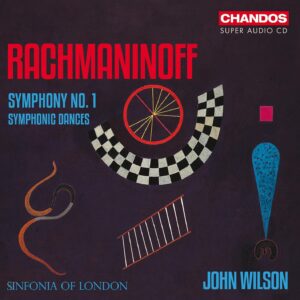
RACHMANINOV: SYMPHONY NO. 1, Sinfonia of London, John Wilson/Chandos SACD With this release John Wilson and his superb Sinfonia of London complete their survey of the three Symphonies and other orchestral works of Rachmaninov for Chandos. The coupling of these two pieces on this SACD is especialy apt, since they span the composer’s creative journey from youthful intensity to mature reflection. Intriguingly, the theme from the final movement of the First Symphony reappears in the ‘Symphonic Dances’, thus linking the two works across decades. Those familiar with John Wilson’s many recordings with the Sinfonia of London will know exactly what to expect from these performances. Orchestral playing of breathtaking precision and bracing verve combined with discipline and outstanding technical security. Wilson’s avowed love of Rachmaninov’s music shines through in both works and, as usual with this conductor, his attention to detail is both meticulous and rewarding for the listener.
Rachmaninov’s First Symphony was written in 1895 when the composer was just 22 years old. However, its first performance in 1897 was a complete disaster. It was badly conducted by Alexander Glazunov and dammed by the critics. When Rachmaninov went into exile in 1917 the score was left in Russia and subsequently lost. In 1944, after the composer’s death, the separate instrumental parts of the symphony were discovered in the Leningrad Conservatory and used to reconstruct the full score. Wilson’s account of this still somewhat neglected work is gripping throughout. From the dramatic opening Wilson carries the musical argument with unerring expertise. Tempi in each of the four movements are felicitous and close to those adopted by Vladimir Ashkenazy on his celebrated (RBCD) recording from 1983 for Decca. Wilson captures the refined melancholy of the Larghetto just as convincingly as the turbulent energy of the finale, complete with its crashing tam-tam strokes. It is, in every respect, a masterly account of this symphony.
Many regard the ‘Symphonic Dances’(1940) as Rachmaninov’s finest orchestral work. Since its premiere by the Philadelphia Orchestra under Eugene Ormandy, it has steadily grown in popularity and has received many fine performances on disc. Wilson emphasizes the work’s rhythmic drive and structural clarity, opting for brisk tempos that heighten excitement and momentum. While this approach does slightly downplay the brooding introspection and nostalgic melancholy of the slower sections, the overall interpretation is undeniably thrilling. The Sinfonia of London responds with blazing virtuosity and infectious energy, particularly in the vitality of the first dance and the menacing grandeur of the finale. It only remains to state, simply for reference, that the final tam-tam stroke in the third dance is curtailed rather than left to resonate into silence as on some other recordings.
Both the Symphony and the ‘Symphonic Dances’ are presented in new editions of the scores; the former by Ed Liebrecht and the latter by Wilson himself. I doubt though that many listeners would detect any differences from what we hear on other performances of these pieces.
The recordings made by the usual expert Chandos team of Ralph Couzens and Brian Pidgeon took place in the Church of St Augustine, Kilburn, London in January and October 2024 and sound on this hybrid multichannel SACD is characteristically excellent – clean, spacious and boasting a wide dynamic range. Those who have enjoyed Wilson’s previous Rachmaninov ecordings will undoubtedly want to add this distinguished release to their collection.