
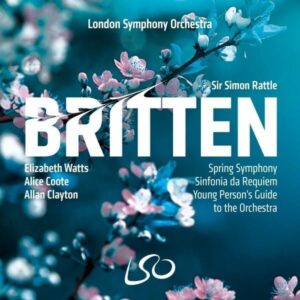
 The music of Benjamin Britten has a been central feature in Simon Rattle’s repertoire since he was a teenager and his authoritative performances both in the Concert Hall and on disc have been widely praised. On this generous filled (79’31”) SACD from LSO Live he revisits two of the composer’s most popular orchestral works that he recorded for EMI with the City of Birmingham Symphony Orchestra back in the 1980s – The ‘Sinfonia da Requiem’ and the ‘The Young Person’s Guide to the Orchestra’ also known as ‘Variations and Fugue on a Theme of Purcell’. The disc also includes Britten’s rarely performed ‘Spring Symphony’ Op. 44
.
Rattle’s most recent account of the ‘Sinfonia da Requiem’– recorded live in the Barbican 7th to 8th of May 2019 – benefits not only from the considerable virtuosity of the LSO’s playing but also the conductor’s more taut approach to the score than on his earlier recording. The opening ‘Lacrymosa’(marked Andante ben misurato) proceeds from its terrifying drum thwacks with implacable power and leads into a fast and superbly articulated ’Dies Irae’. Rattle’s handling of the music’s disintegration after its final climax is immaculate and leads seamlessly into a Mahlerian ‘Requiem aeternam’ that is poignant, but taken by the conductor at a pace that eschews any gratuitous sentimentality.
Britten’s ‘Spring Symphony’, here making its first appearance in high resolution sound, was a commission from the Koussevitsky Music Foundation in1947, but was not completed until two years later. Arguments as to whether this work is a true symphony or an extended song cycle for large forces on the subject of its title may rage, but there can be little doubt that Rattle’s commanding account of this complex score could hardly be improved upon. He has assembled a first rate team of soloists for his rendition led by the excellent tenor Alan Clayton (an outstanding Peter Grimes), mezzo-soprano Alice Coote and soprano Elizabeth Watts while the various Tiffin Schools’ choirs and the London Symphony Chorus acquit themselves with considerable distinction.
Britten uses his large orchestral forces that includes triple woodwind, four percussionists and two harps with restraint rarely involving the entire orchestra. The spare orchestral textures of the Introduction ‘Shine out, fair sun’ that perfectly evoke the icy chill of winter are captured with clarity by the recording and as the work proceeds it is clear that the Classic Sound engineers have done a splendid job ensuring that every detail of Britten’s unconventional scoring can be perceived by the listener.
The excellent liner notes provide a detailed guide to the Symphony as well as the English texts fastidiously chosen by Britten that, W H Auden apart, are taken predominantly from anthologies of 16th and 17th verse.
The ‘Young Person’s Guide to the Orchestra’ of 1945, arguably Britten’s most popular orchestral work needs no introduction. Rattle’s incisive and polished account of this score is in the same league as the composer’s 1964 recording with this same orchestra and completes this most satisfying programme in fine style.
An unqualified recommendation is warranted.