
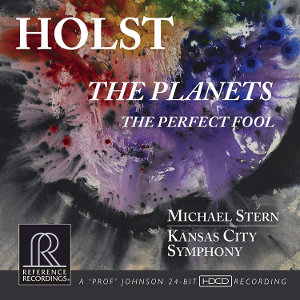
HOLST: THE PLANETS, Kansas City Symphony, Michael Stern/Reference Recordings SACD It’s hardly a surprise that the Kansas City Symphony under Michael Stern provide one of the most wide-ranging and dramatic readings of Holst’s imperishable masterpiece on record. While not perhaps unseating some of the great readings of the past, this is still in the upper echelons of recordings of The Planets, and it goes without saying that the customarily panoramic Reference Recordings aural palette does full justice to the composer’s still astonishing (and much-imitated) orchestration. This hybrid SACD release was recorded in the acoustically splendid Helzberg Hall, Kauffman Center for the Performing Arts. The producer was the multi-award-winning David Frost, with the legendary Technical Director Keith O. Johnson working with engineer Sean Martin. The results speak for themselves.
SHOSTAKOVICH:THE BEDBUG • LOVE AND HATE, Mannheim Opera Choir • Deutsche Staatsphilharmonie Rheinland-Pfalz, Dani Juris, Mark FitzGerald/Naxos With certain composers – not noted for being prolific – the listener has to be content with a relatively slender body of work. Fortunately, Shostakovich was not among that number, and admirers (who are legion) have a great deal of available music to slake their thirst, from his 15 symphonies to his remarkable series of string quartets, possibly the finest contribution to the medium (apart from those of Bartok) in the 20th century. The dedication that recording record companies have shown over the years has meant that virtually every piece is now available – but as this new Naxos issue shows, there are still corners to be illuminated. These pieces (it has to be admitted) are hardly major finds, but they still have a modest piquant value for the followers of the composer. Shostakovich was still young when hired to provide incidental music for The Bedbug, a surreal and farcical satire on Communist utopian dreams and bourgeois corruption and vulgarity. The score, newly reconstructed by Mark Fitz-Gerald from rough piano sketches and the 1935 soundtrack, combines symphonic sections with popular songs.
BLISS: MARY OF MAGDALA, THE ENCHANTRESS, MEDITATIONS ON A THEME BY JOHN BLOW, Dame Sarah Connolly, James Platt, BBC Symphony Chorus, BBC Symphony Orchestra, Sir Andrew Davis/Chandos Admirers of the composer Arthur Bliss may find that the most attractive item on this new surround sound disc on the Chandos label is one of his finest pieces, the Meditations on a Theme by John Blow, appearing here in its first incarnation in the SACD medium. Sir Andrew Davis does full justice to the colourful, inventive score. If the choral works on the disc are more for the Bliss completist, it’s still very collectable. Davis continues his championship of the lesser-known works of Bliss with this coupling of The Enchantress with Mary of Magdala. The always exemplary Dame Sarah Connolly and James Platt are the soloists, with the BBC Symphony Orchestra and Chorus.
BEETHOVEN: SYMPHONIES 1 & 5, Budapest Festival orchestra, Ivan Fischer/Channel Classics SACD & BEETHOVEN: SYMPHONIES 5 & 6, Marek Janowski and the WDR Symphony Orchestra/Pentatone SACD Commentators on classical music are wont to lament the superfluity of recordings of the Beethoven symphonies, but it’s hardly surprising that every conductor worth his salt wants to put his or her own stamp on these cornerstones of the classical repertoire. The common denominator of the two discs above is the mighty Fifth Symphony, and more and more performances are now appearing in the surround sound medium. Speaking of the latter, Carlos Kleiber’s DG reading — in its SACD incarnation — remains the definitive modern reading, but both of these have much to offer, notably the Ivan Fischer, which incorporates much of the kinetic energy that Kleiber’s white hot reading is famous for. And both Fischer and Janowski are granted performances of great dynamic range, courtesy of Channel Classics and Pentatone respectively. This is Janowski’s second collaboration for the label with the WDR Symphony Orchestra, one of the most key radio orchestras of Germany.
ANTHEIL: ORCHESTRAL WORKS, VOL. 3, BBC Philharmonic, John Storgårds/Chandos There was a time when aficionados of the composer George Antheil were obliged to collect his music piecemeal, but now they are in the fortunate position of having two excellent cycles available on disc. The dynamic performances of the composer’s orchestral music conducted by Hugh Wolff on CPO were a conspicuous successes (and a benchmark), but now we have a rival in this lively and attractive new series by John Storgårds and the BBC Philharmonic in which the recording quality (while not surround sound) perfectly complements and enhances the dramatic scores. The third volume in this series of works by George Antheil includes his Capital of the World Suite and First Symphony.
MOZART: VIOLIN CONCERTOS 1 & 5, Gordan Nikolic, Netherlands Chamber Orchestra/Tacet SACD These much-loved pieces have been much recorded, but Mozart’s violin concertos have never before been granted the total surround iterations that they receive here — in other words, the listener is placed at the centre of the orchestra, as is the Tacet label’s trademark. Sympathetic and pointed performances are enshrined in recordings of great range and impact, though a taste for this particular audio setup is recommended.
THREE FROM BMOP/Sound
WILLIAM SCHUMAN: THE WITCH OF ENDOR, JUDITH, Night Journey/Boston Modern Orchestra Project, Gil Rose/BMOP/sound SACD This is an accomplished disc, essential for admirers of the talented American composer William Schuman. His ballet suites Judith and Night Journey have been recorded before but never in the kind of wide-ranging surround sound that they are accorded here. As a further incentive to purchase, the disc also contains what is (as far as I can tell) the first recording of another Schuman ballet for Martha Graham, the knottier The Witch of Endor. Admirers of Schumann will know that his music does not always give up its secrets immediately (Judith is the most approachable ballet here), but the sheer physical impact of the scores is considerable and for aficionados of key American Symphonists of the 20th century, it’s a desirable purchase. Performances by Gill Rose and the Boston Modern Orchestra Project do full justice to the music.
SANFORD: BLACK NOISE, Boston Modern Orchestra Project, Gil Rose/BMOP Sound Boston Not for the casual listener, but those with a taste for the adventurous might give this unusual disc a try. BMOP is recognised as the USA’s foremost label launched by an orchestra and devoted exclusively to new music. Black Noise is performed by the enterprising musicians of the Boston Modern Orchestra Project (BMOP) and led by conductor Gil Rose. This disc will, in Sanford’s words, “promote and normalize the contribution and participation of Blacks in classical music.” Spanning 20 years of the composer’s career, the album features three pieces that have significantly contributed to the expansion of Sanford’s career and reputation: Black Noise, Prayer: In Memoriam Dr. Martin Luther King Jr.; and the orchestral version of the genre-bending cello concerto, Scherzo Grosso, with soloist Matt Haimovitz. The patient listener will be rewarded, though this will not be to every taste.
COLGRASS: SIDE BY SIDE, Boston Modern Orchestra Project, Gil Rose /BMOP/sound Boston Large-scale works referencing the past are on offer here, music that will be unfamiliar to most listeners. Michael Colgrass: Side by Side features three of the composer’s works for large ensemble performed by the Boston Modern Orchestra Project (BMOP) and led by conductor Gil Rose. An American-born Canadian living in Toronto, the Pulitzer Prize-winning and Emmy Award-winning Colgrass holds the unique distinction among prominent classical composers in North America of being the only one whose music is well known equally on both sides of the Canadian-American border. The album begins with the complex Letter from Mozart that takes listeners on a journey asking them to imagine a fictional letter from Mozart to the composer (“Michael”) imploring him to write a piece of music using one of Mozart’s themes as a point of departure.
SHOSTAKOVICH SYMPHONY NO. 4, London Symphony Orchestra, Gianandrea Noseda/LSO Live SACD Once again, Gianandrea Noseda demonstrates his mastery of the music of the troubled Russian master Shostakovich with an incendiary performance of this once-suppressed masterpiece that finds the essence both its shattering drama and keening poignancy. The reading is matched by a typically breathtaking LSO Live SACD recording captures the balanced sense of structure that Noseda brings to the piece.
HANDEL: SAMSON, Soloists, Dunedin Consort, John Butt/Linn Many classical listeners over the age of forty will have become familiar with the signature aria from Handel’s oratorio Samson, Total Eclipse, via stirring (but inauthentic) performances from such singers as Richard Lewis. How things have changed. This new performing edition of one of Handel’s great works features (along with boy troubles) new thinking and approaches by the conductor John Butt, leading to what he considers to be an authentic rendition, honouring the composer’s original intentions – or at least as far as it is possible in the modern age. The performance itself is, needless to say, utterly splendid and makes the best introduction to the piece for modern listeners.
HANCOCK: RAPTURES, Jack Liebeck, BBC Concert Orchestra, Levon Parikian/ORCHID CLASSICS Some years ago, the writer John McLaren was involved with a prize for accessible modern music (as opposed to the rebarbative variety, which alienates many listeners). The prize was in the event discontinued for lack of interest, but there is still a taste for attractive modern orchestral music in the tonal idiom. The present disc would have made a good entry for the prize if it were still around, even though the music (for all its easy appeal) is not strikingly individual. Nevertheless, Hancock’s work is always tuneful and attractively orchestrated. In demand as composer for film and television, Stuart Hancock is winning new admirers. We are given here world premiere recordings of his Violin Concerto, with Jack Liebeck as soloist, and two other pieces for full symphony orchestra. The British composer’s admiration for Hollywood scoring flows informs the album’s opening track, Variations on a Heroic Theme.
BRAHMS: SYMPHONIES NOS 1 AND 3, Bergen Philharmonic Orchestra, Edward Gardner/Chandos SACD In the review of Beethoven symphonies above, it was pointed out that the classical disc repertoire is groaning under the weight of hundreds of such readings of this much-visited music, and the same might be said for the Brahms symphonies — inspired, of course, by Beethoven’s example. The conductor Edward Gardner is on something of a roll at the moment, so it is not surprising that his readings of Brahms one and three are among the best of recent takes on the pieces, without perhaps matching the sheer electricity and focus of some of his recent recordings for Chandos. Nevertheless, this is an extremely pleasing and collectable disc. This first instalment in a new Brahms series from Edward Gardner showcases the Bergen string section along with impeccable ensemble playing from the orchestra. Recorded in Chandos’ splendid surround sound idiom.
PROKOFIEV: ALEXANDER NEVSKY, LIEUTENANT KIJÉ SUITE, Alisa Kolosova, Utah Symphony, Thierry Fischer, Utah Symphony Chorus, University of Utah A Cappella Choir, University of Utah Chamber Choir, Barlow Bradford Many listeners of a certain age will conjure up images from the famous Sergei Eisenstein film when listening to this celebrated score, notably the famous battle on the ice with the cruel Teutonic Knights meeting a cold and watery doom. There have been many fine recordings of the score over the years, but few have had the sheer impact of this performance, particularly in the SACD recording it is granted here. In 1938 Prokofiev was given a commission to score (for director Sergei Eisenstein) the music for the film Alexander Nevsky. The collaboration was highly successful, and produced one of the key historical films of the century. Director of the Utah Symphony Thierry Fischer draws from his orchestra remarkable results, closer to Prokofiev’s markings than other recorded performances. The soloist in the sixth movement ‘The Field of the Dead’ is the Russian mezzo-soprano Alisa Kolosova. The disc is completed by the Lieutenant Kijé Suite, one of Prokofiev’s most popular works, only the fourth to appear on SACD in surround sound.
MAHLER: SYMPHONY NO. 1, Minnesota Orchestra, Osmo Vänskä/BIS SACD How to choose from the dozens of recordings of Mahler’s epic first Symphony? This new take by the Minnesota Orchestra, under Osmo Vänskä is a very serviceable reading, foregrounding orchestral clarity. Mahler’s first symphony, which the composer originally gave the subtitle ‘Titan’, borrows extensively from the song cycle Lieder eines fahrenden Gesellen. But Mahler also incorporates elements of Moravian popular music (in the second movement) and – in the slow third movement – famously quotes a minor-mode version of the children’s rhyme Bruder Martin (also known as Frère Jacques). The finale transports the listener to a world of Gothic theatricality reminiscent of Grand Opera, before arriving – after a number of false starts –at the symphony’s heroic chorale-like ending.
BARTÓK: BLUEBEARD’S CASTLE, Michelle DeYoung, John Relyea, Pál Mácsai, Bergen Philharmonic Orchestra, Edward Gardner/Chandos SACD A highly impressive take on Bluebeard’s Castle. While not displacing some classics readings of the past, Edward Gardner’s is a highly impressive reading of one of the great modern operas. While not displacing some classics is a vivid and colourful reading of Bartok’s operatic masterpiece, the famous opening of the forbidden door (accompanied by a floor-shaking organ) is as vividly dispatched as it has ever been. Following acclaimed performances around the globe, John Relyea’s interpretation of Duke Bluebeard now appears on record, with Michelle DeYoung as Judith and Edward Gardner leading his Bergen forces with aplomb.
BACH ORGAN WORKS, VOL. 3, Masaaki Suzuki/BIS SACD The recordings of Bach’s organ music are legion, but the SACD recording accorded to Masaaki Suzuki here does full justice to the organ timbre, placing the listener in something like the acoustic in which the pieces were recorded. The organ maker Silbermann was based in Freiberg with his workshop only a stone’s throw away from the cathedral, where he built his first great organ in 1714. One of the finest and best preserved examples of his art, this is the instrument which Masaaki Suzuki has chosen for the third instalment in his traversal of Bach’s organ music, following acclaimed recitals recorded in Gronin.
KHACHATURIAN: CELLO CONCERTO, CONCERTO RHAPSODY Torleif Thedeen, SRP, Daniel Raiskin/CPO Two perfectly acceptable readings of colourful pieces by Aram Khachaturian which have not enjoyed the currency of his more popular works such as the suite from the ballet Spartacus. While not the finest takes these pieces have received, these are nevertheless readings of great musicianship, in stereo rather than surround sound.
SAINT-SAËNS: ASCANIO – BALLET, ANDROMAQUE • LES BARBARES, LA PRINCESSE JAUNE, Malmö Symphony Orchestra, Jun Märkl/ Naxos A splendid recent Chandos disc conducted by Neeme Järvi managed to contain most of the composer’s Saint-Saëns’ key orchestral works, but as this new issue proves, there are still some discoveries to be made, even if (despite their charm) they are not among the composer’s most substantial works. Saint-Saëns’ operatic works contain instrumental music of colour and invention but have been largely overlooked. Ascanio contains a substantial and elaborate divertissement that fellow composer Reynaldo Hahn termed ‘the entire Renaissance in a few pages’. Les Barbares, a tale of conquest and revenge, includes a vivid Prologue and joyful ballet, while La Princesse jaune with its pentatonic writing, and La Jota aragonese is spiced with Spanish vitality.
SHOSTAKOVICH: STRING QUARTETS, 2, 7 & 8, Pavel Haas Quartet/Supraphon While classical music collectors are spoiled for choice where these modern masterpieces of the string quartet medium are concerned, these reading of Shostakovich’s quartets 2, 7 and 8 are among the most significant of recent years — and while not accorded the final ounce of fidelity that the SACD medium would have given them, the recording is still mightily impressive.
GROSLOT: CONCERTOS FOR PIANO, CELLO AND HARP, Jan Michiels, PianoIlia Yourivitch Laporev, Cello, Eline Groslot, Harp, Brussels Philharmonic Orchestra, Robert Groslot/Naxos A recent issue of the composer Groslot’s orchestral music (also from Naxos) whetted the appetite for more from this unfamiliar musician. If, however, this second issue is notably less striking, it is still evidence of an unusual talent, with a particular ability to explore the furthest reaches of the instruments involved in the various concerti here. And there is no denying musicianship on offer from Jan Michiels and co.