
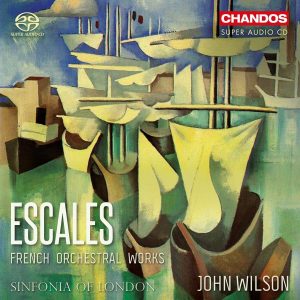
ESCALES: FRENCH ORCHESTRAL MUSIC, Sinfonia of London, John Wilson/Chandos Hybrid SACD What a cornucopia! No previous disc has offered this particular combination of exquisite French music before, all served up with the wide-ranging panoply of sound that is a Chandos hallmark. And the disc is further proof of the conductor John Wilson’s all-encompassing range. The standout selection here is the tone poem that gives the collection its title: Ibert’s languorous and beautiful Escales, rarely delivered as seductively as here. But equally winning is Wilson and the Sinfonia of London’s reading of Ravel’s charming Rapsodie Espagnole, full-blooded and exhilarating. Which is not to say that the other pieces on the disc (including Debussy’s much-recorded amorous faun and Chabrier’s España) do not receive marvellous readings. Wilson’s orchestra may be of the pick-up variety, but it’s a Rolls Royce of such groups, with rich applications of passion and musicianship. Chandos has promised Respighi from these forces – news that will whet many an appetite.
VAUGHAN WILLIAMS: SYMPHONY NO. 3 ‘PASTORAL’; SYMPHONY NO. 4 IN F MINOR; SARABAND ‘HELEN’, Elizabeth Watts, David Butt Philip, BBC Symphony Chorus, BBC Symphony/Hyperion It is strange to note that over the years, the recordings of Vaughan Williams’ two most dynamic symphonies, the Fourth and the Sixth, have rarely shared the same disc. Perhaps the feeling is that the muscular and nervy Fourth is best coupled with a more introspective piece – which is the case here. While sadly not in the SACD sound that used to be one of the glories of the Hyperion label, this coupling is both strikingly recorded and exquisitely played, with every poetic nuance of the Pastoral Symphony lovingly coaxed out by David Butt Philip and the BBC Symphony. If the Fourth has enjoyed more pulse-racing readings (such as that by Richard Hickox), rarely has its superbly wrought architecture been so cogently defined. Butt’s readings here are to cherish for Vaughan Williams aficionados, And there is a very collectable fill-up: the first recording of Sarabande: ‘Helen’, very much in the vein of the Serenade to Music.
KHACHATURIAN: PIANO WORKS, Iyad Sughayer, piano/BIS HYBRID SACD There are certain composers whose very popularity renders them slightly suspect in some eyes – surely (the thinking goes) such mass appeal cannot be aligned with the most rigorous of artistic intentions? It’s nonsense, of course, but such talented musicians as Khachaturian suffered from this snobbery, even though it has to be admitted that sometimes his music is relentless (although never less than exhilarating). The popularity of the composer’s ballets – particularly Spartacus – is unarguable, but his piano music is less well-known, and is well deserving of attention – particularly when it is as well played as it is here by Iyad Sughayer. What’s more, this is the first time this music has appeared in the surround sound medium. Born in 1903, Aram Khachaturian was a key figure in the then-Soviet Republic of Armenia. For his début disc, the Jordanian-Palestinian pianist Iyad Sughayer has arranged a programme stretching from the formidable Sonata to the playful Children’s Album, consisting of ten charming miniatures.
BEETHOVEN COMPLETE STRING QUARTETS, Miro Quartet/Pentatone There is, perhaps, a superfluity of choice in the greatest series of string quartet by any composer, those of Beethoven — but this is a highly competitive set, with the Miro Quartet demonstrating a combination of scholarship and spontaneity that is very winning. The sound (while not Pentatone’s customary surround sound) is suitably detailed and analytical.
GOOSENS: ORCHESTRAL WORKS VOLUME 3: SYMPHONY No. 2, PHANTASY CONCERTO, Tasmin Little, Melbourne Symphony orchestra, Andrew Davis/Chandos HYBRID SACD The music of the neglected English composer Eugene Goosens continues its upward trajectory, and those sampling this extremely winning disc from Chandos (showcasing that company’s customarily impressive surround sound) will wonder why the music of Goosens has languished so long in the wilderness. This is British orchestral music at its most comprehensively impressive, and is easily the equal of symphonies by such contemporaries of the composer as Malcolm Arnold. New listeners might profitably sample the exciting finale to the Second Symphony: just a few seconds (particularly the pulse-racing coda) will persuade those unfamiliar with Goosens to investigate further. And the two earlier discs in the series should be investigated without hesitation.
MOZART: STRING QUARTET IN C MAJOR KV 465 “DISSONANCE”, STRING QUARTET IN B FLAT MAJOR KV 458 “THE HUNT”/Auryn Quartet/Tacet Those familiar with the Tacet label’s genuine surround sound strategy (which places the listener dead centre in any recording enterprise) will know the edge-of-the-seat feeling that such readings can give – very much the case with these dedicated performances of two of Mozart’s named quartets.
DVORAK: SYMPHONY NO. 9, COPLAND: BILLY THE KID, National Symphony Orchestra, Gianandrea Noseda/NSO Hybrid SACD Recordings of the New World Symphony are, of course, legion, and something special is required to render any new entry competitive. But it has to be said that Gianandrea Noseda and the National Symphony Orchestra (for a new SACD label) deliver a beautifully balanced but always exciting performance of this most popular of symphonies, and the recording from the John F. Kennedy Center for the Performing Arts is in the very first rank. Regarding the odd choice of a companion piece, Copland’s Billy the Kid, there was a time when it was felt that only American conductors could bring out the best in this music (a similar syndrome operated in reverse for the symphonies of Vaughan Williams), but that canard is now history – as this energetic performance from Noseda proves.
HANDEL CONCERTI GROSSI OP.6 PART 2, Akademie für Alte Musik Berlin, Bernhard Forck/Pentatone If your familiarity with Handel extends no further than Messiah, the Water Music and the Royal Fireworks Music, here is a perfect opportunity to extend your acquaintance with this most gifted of musicians. The Akademie für Alte Musik Berlin continue their Handel trilogy with this recording of the last six concerti grossi of the composer’s Op. 6. Originally designed as attractive interludes to English oratorio performances, Handel’s concerti grossi soon gained fame as some of the most appealing orchestral music of the baroque era.
BACH: THE WELL TEMPERED CONSORT I, Phantasm/Linn ‘Phantasm’ is a viol ensemble who here provide one of the most unusual realisations of Bach’s keyboard masterpiece. Attention to beauty of sound and balance is paramount, and if other versions with different orchestration find more colour in the piece, it is still a very persuasive account – although perhaps not one to be listened to in toto without a degree of aural fatigue.
TCHAIKOVSKY, BARBER: VIOLIN CONCERTOS, Johan Dalene, Norrköping Symphony Orchestra, Daniel Blendul/BIS Hybrid SACD The current recording program undertaken by the BIS label continues to add highly impressive readings of both familiar and unfamiliar pieces, always couched in the superb surround sound that is one of the company’s trademarks. Johan Dalene and the Norrköping Symphony Orchestra with Daniel Blendul provide a distinctive performance of the much-recorded Tchaikovsky Concerto, but it is the reading of Samuel Barber’s less well-known American masterpiece that makes the disc particularly collectible; a performance to sit alongside the very best it has received.
ANTHEIL: SERANADES 1 & 2; THE GOLDEN BIRD; DREAMS, Württembergische Philharmonie Reutlingen, Fawzi Haimor/CPO More welcome excavations of the American composer once known as ‘The bad boy of music’. Nothing too frightening about these winning pieces, which represent Antheil at his most approachable. The two Serenades in particular are very winning.
MAHLER: SYMPHONY NO. 4,Carolyn Sampson, Minnesota Orchestra, Osmo Vänskä/BIS HYBRID SACD If your first acquaintance with Mahler’s Fourth Symphony was in more forceful readings, you may take some time to adjust to the more restrained take it is given here by the Minnesota Orchestra under Osmo Vänskä. Nevertheless, this is an extremely musical reading, highlighting the exuberance and the uplifting spirit of the piece, with a nicely judged sense of childlike wonder in the soprano-led final movement.
TCHEREPNIN: NARCISSE ET ECHO, OP. 40; LA PRINCESSE LOINTAINE, OP. 4; SYMPHONIC PRELUDE, Moon Yung Oh, Ein Vokalensmble, Bamberger Symphoniker, Lukas Borowicz/CPO If the premiere Chandos recording by Rozhdestvensky of Narcisse et Echo remains the definitive take on this glorious (if undervalued) piece, this remains a reading which does full justice to the sumptuous music on offer here. There is a particularly apposite shaping of climaxes, with both the more forceful passages and the more lyrical sections giving the fullest expression.
RACHMANINOV: PIANO CONCERTO NUMBER ONE, RHAPSODY ON A THEME OF PAGANINI, PRELUDES, Anna Fedorova, Sinfonieorchester St. Gallan, Modesta Pitrenas/Channel Classics While there is no shortage of impressive performances of these Rachmaninov classics, Anna Fedorova and the Sinfonieorchester St. Gallan under Modesta Pitrenas give particularly persuasive accounts, with the Rhapsody having the right propulsive element when necessary, alongside the limpid beauty of the 18th variation.
HANDEL: MESSIAH, Soloists, Hervé Niquet/Chateau de Versailles DVD With crisp, detailed picture and sound, this live performance of Handel’s most loved oratorio will please many, not least for its impeccable quartet of soloists with Sandrine Piau particularly distinguished in her arias. The excitement of a live performances comes across, and the only caveat here might be that the disc is a DVD rather than a more analytical Blu-ray.
SCHUMANN: SYMPHONIES ONE & THREE, MANFRED OVERTURE, London Symphony Orchestra, Sir John Eliot Gardiner/LSO Live HYBRID SACD Long regarded as securely at the pinnacle of his profession, Sir John Eliot Gardiner is currently doing some of the best work of his career — as these expressive and vibrant performances of Schumann’s orchestral music attest. What’s more, the performances are caught in the most impressive SACD sound with the problems of Barbican recording fully overcome.
COULEURS: POULENC: PIANO CONCERTO, SINFONIETTA, KOECHLIN: TONE POEMS, Arturo Pizarro, Bamberger Symphoniker, Thomas Rosner/ Odradek Records. The Poulenc pieces on offer here have enjoyed some very characterful performances over the years, and these new readings are as lively and colourful as any. The selling point is perhaps the rare Koechlin tone poems — pieces which do not perhaps possess the immediate appeal of his Jungle Book cycle but are worth persevering with to winkle out their supple and attractive writing.
LIEDERKREIS: DECADES: A CENTURY OF SONG, VOLUME 4 1840 – 1850, soloists, Malcolm Martineau/Vivat This impressive series has enjoyed much critical acclaim for its earlier volumes, but the fourth entry really is something special, whetting the appetite for the remaining six issues. Vivat’s impeccably chosen singers present a century of song and composers (notably Schumann), given the kind of subtle advocacy that only the most gifted singers can provide. Recording quality is exemplary.
BEETHOVEN: FUGUES AND RARITIES FOR STRING QUARTET, GROSSE FUGE, PRELUDES AND FUGUES, Fine Arts Quartet/Naxos It is something of a cliché that when a conductor signs with a new record label, their first request is to commit to disc a set of the Beethoven symphonies – even though the label may already have more than one formidable set in its list — and that the cycle already has countless iterations available. Less popular but still regarded as the summit of their genre are the composer’s string quartets, and there are, similarly, many alternative readings deserving of attention. But there is music for the quartet medium by Beethoven which is far less well known. The string quartets are among the finest works in music, but Beethoven composed other works for quartet which have been overlooked – such as the rarities found here. We have the original versions of his quartets Op. 18, No. 1 and Op. 131, plus six unknown miniatures, including his Preludes and Fugues. All are impeccably played by the Fine Arts Quartet.
KORNGOLD, BERG, ZEMLINSKY, SCHOENBERG, MAHLER: JUGENDSTIL: SONGS 1898-1916, Camilla Tilling, Paul Rivinius/BIS HYBRID SACD This particular program of late romantic songs presents a mixture which has never been found on the same disc before, but such are Camilla Tilling and Paul Rivinius’s sympathetic and nuanced readings tat it’s hard to imagine better performances (except in the case of the Mahler cycle, Ruckert Lieder which comes up against some formidable competition, not least that of Janet Baker).
BEETHOVEN: VIOLIN CONCERTO, STRING TRIO OPUS 3, Daniel Gaede, Polish Chamber Philharmonic Orchestra, Wojciech RAJSKI/Tacet HYBRID SACD The sheer immediacy and passion of this stunningly recorded take on Beethoven’s masterpiece cannot be gainsaid; while not perhaps unseating some of the classic readings of the past, this is still mightily impressive, and the concerto has rarely sounded so stunning in terms of recording quality.
KAPP, LUDI & LEMBA: ORCHESTRAL WORKS, Estonian National Symphony Orchestra Neeme Järvi/Chandos Classical listeners – even those of adventurous mien — will be unlikely to have encountered the names of the composers on this disc, but admirers of the conductor Neeme Järvi and his eclectic tastes may be tempted to try this late romantic fare. Estonian symphonic music has not made a great impression on the repertoire, but the three composers to be found on this disc reward attention, albeit that there are no undiscovered masterpieces.