
GRAHAM WILLIAMS WRITES:
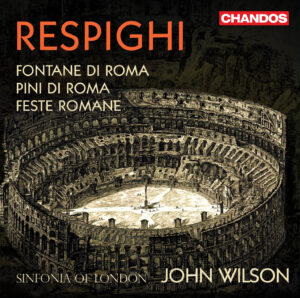
RESPIGHI: ROMAN TRILOGY, Sinfonia of London, John Wilson/Chandos SACD John Wilson’s two recordings on SACD with the Sinfonia of London, the first of music by Korngold and the second of French orchestral works, have garnered numerous accolades not only for the quality of the performances but also for the superb sound quality that the Chandos engineers accorded him and his hand-picked orchestra. That body, relaunched as a recording orchestra in 2018, comprises of an outstanding group of musicians who meet several times a year for specific projects. The orchestra includes a significant number of principals and leaders from orchestras based both in the UK and abroad alongside notable soloists and members of distinguished chamber groups. The fresh and persuasive playing displayed by these musicians in the first two recordings are now brought to bear on the music of Ottorino Respighi.
For his third recording with this orchestra Wilson has chosen the three symphonic poems that comprise Respighi’s Roman trilogy – The Fountains of Rome (1914-16), the Pines of Rome (1923-24) and Feste Romane (1928). Though these evocative and stunning orchestral show pieces have been recorded countless times and championed by many distinguished conductors of the past, they never fail to make an impression whether in the concert hall or on disc.
Most recordings of the Roman trilogy place the three works in the order of their composition but on this disc Feste Romane, for a reason not apparent to me, is presented first. Its opening movement ‘Circences’ is performed with an astonishing attack and ferocity that will pin you to your seat. This typifies Wilson’s propulsive and consistently dynamic approach to the music throughout these accounts. It is worth mentioning here that the full weight of the organ pedal notes used by Respighi at various points in these scores is appropriately floor trembling on this Chandos disc, something that is often lacking in some rival versions. As a manipulator of musical sonorities Wilson is an absolute master and he captures the various moods of this music and its expressive potential with unerring skill. His tempi, though fleet-footed, are convincingly flexible and ensure that the sensuously luxurious textures of, for example, the outer movements of the Fountains of Rome, are not short-changed.
In all three of these works it is clear that Wilson knows exactly what he wants and his players oblige with commendable enthusiasm. The Sinfonia of London has a lustrous sound that is cohesive and impeccably blended. Its musicians clearly revel in the virtuosity that Respighi requires of them producing wonderfully manicured orchestral timbres that do full justice to the wealth of beguiling orchestral effects present in these scores.
The excellence of Wilson’s Sinfonia of London response to these sonically opulent pieces is matched by that of the recorded sound superbly engineered in 24-bit / 96KHz and 5.0 channel surround by engineer Ralph Couzens. The venue was the Church of St Augustine Kilburn, London (2-7 September 2019). The acoustic of the church provides a wonderful sense of space that remains open, vivid and detailed even in the heaviest orchestral climaxes and there are many of those in these three pieces. Photographs of the recording sessions in the accompanying booklet show the orchestra packed into the nave with the additional brass in the gallery.
Wilson’s only direct competition on multi-channel SACD (which is what this music surely requires) is the excellent BIS version recorded in 2008 from John Neschling and the São Paulo Symphony Orchestra. Some might prefer Neschling’s less dynamic approach to these scores while others would miss the visceral thrill of Wilson’s galvanic conducting. Respighi aficionados will want both versions in their collections together with the classic 1959 Reiner recording of the Fountains and the Pines, in one of its iterations, that still sounds amazing sixty years on!
These vivid and compelling performances can be enthusiastically recommended.
BACH: ICH RUF’ ZU DIR, HERR JESU CHRIST, BWV 639, ICH HABE GENUG, BWV 82, ORCHESTRAL SUITE IN B MINOR, BWV 1067, Stephan Genz (baritone), Russian National Orchestra, Metropolitan Hilarion Alfeyev’Pentatone SACD
A recording of four of J S Bach’s Religious and Secular works performed by the Russian National Orchestra and conducted by a composer who is not only a distinguished cleric of the Orthodox church but also a prolific author of more than a thousand publications on theology, history and musicology – what’s not to like? This is certainly an intriguing release though one that will divide opinion, mostly with regard to the style of the performances rather than the recorded sound which is superb.
Metropolitan Hilarion Alfeyev is apparently one of the most widely performed of all living Russian composers, and in the notes accompanying this SACD he makes his approach to Bach quite unequivocal – “As a conductor, I feel deeply indebted to such interpreters of Bach’s works as Karl Richter and Herbert von Karajan. I am not at all fascinated by the modern fashion to play Bach in the so-called “authentic” style, whatever it may mean, when the orchestra is tuned one tone lower (which is unbearable for people with perfect pitch), the tempos are too fast, and the entire manner of performance is artificially oriented towards what is believed to be peculiar for Bach’s epoch.”
It should be self evident from the above that period performance zealots should read no further, but more open minded listeners, who listen with their ears not their prejudices to Bach performed in a manner that has enthralled listeners for more than a century, will surely find much to enjoy. Appreciation of the universality and profound spirituality of Bach’s music has never been dependent on search for ‘authenticity’ or fashion in contemporary interpretation, however worthwhile and enlightening these might be.
Alfeyev’s arrangement for orchestra of one of the most well known of Bach’s chorale preludes – ‘Ich ruf’ zu Dir, Herr Jesu Christ’ BWV639 from Das Orgel-Büchlein – opens the programme. His transcription of this richly melodic piece, that here features solos for trumpet and oboe, is most effective. Though sumptuous, it is in no sense over-inflated and is certainly worthy to join the many Bach transcriptions made by famous conductors of the past such as Leopold Stokowski.
The five-part Cantata ‘Ich habe genug’ BWV82 is sung with considerable sensitivity by the German baritone Stephan Genz. He delivers the recitatives in a forthright and dramatic manner, while each of the three arias are performed with a smooth legato, fine diction and an almost conversational intimacy. In conjunction with the steady tempi of Alfeyev’s accompaniment we are presented with a richly expressive account of the work. It is a pity though that the liner notes do not include texts and translations
Bach’s 2nd Orchestral Suite BWV1067 features the fine flute playing of Alya Vodovozova who is quite forwardly balanced against what sounds like a large body of strings. Alfeyev’s stately tempo for the opening Overture emphasises its ceremonial character while the fugal middle section is affirmatively buoyant. The six movements that follow are stylistically varied; for example we have a quite romantic ‘Sarabande’, while the faster sections are performed at tempi that makes them seem truly ‘danceable’. A crisply delivered ‘Badinerie’ brings this imposing performance of the Suite to a close.
The highlight of this SACD is undoubtedly Alfeyev’s stunning arrangement for full orchestra of Bach’s organ Passacaglia and Fuge BWV582. Many conductors including René Leibowitz, Eugene Ormandy, Sir Andrew Davis as well as the aforementioned Leopold Stokowski have been tempted to enhance the majesty and monumental grandeur of this magnificent piece by using the resources of the modern symphony orchestra. Respighi’s ‘Passacaglia in do minore di Giovanni Sebastiano Bach’ is perhaps the most well-known realisation of this composition, but Alfeyev’s glittering orchestration is more than a match for that of the Italian master.
This transcription opens with the Passacaglia theme solemnly intoned by the rich lower brass of the RNO, to be followed by trumpets and horns. The texture lightens as the woodwind and strings enter, and as the variations unfold Alfeyev uses his huge orchestra with considerable skill to suggest the varied registrations that an organist might use. The piece’s inexorable progress builds to a final climax with thunderous timpani, tubular bells and tam-tam rolls reminiscent of the closing pages of Mahler’s Resurrection Symphony or Respighi’s Pines of Rome – altogether a thrilling sound and one that provides quite a workout for one’s hi-fi system.
The fine multi-channel DSD recordings were made in 2015 by the highly regarded Polyhymnia team (Producer and editor Erdo Groot and Balance engineer Jean-Marie Geijsen) in an unspecified Moscow location and they do full justice to the performances.
Certainly this is an unusual release to find in these “Historically Informed Performance” times, but with the caveats above, it is one that I have no hesitation in recommending.