
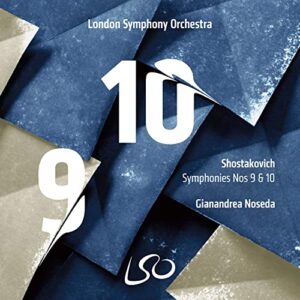
SHOSTAKOVICH: SYMPHONIES NOS 9 & 10, London Symphony Orchestra, Gianandrea Noseda/LSO LIVE SACD The complete set of Shostakovich symphonies conducted by Kitajenko on Capriccio remains the yardstick for complete cycles of these works in the SACD medium. While enthusiasts for that set might have had the odd caveat, Kitajenko’s total achievement has been hard to beat. But now thanks to the London Symphony Orchestra under Gianandrea Noseda, we have a newly developing set that more than matches the Kitajenko set in terms of fiery, dramatic performances and wide-ranging impactful sound. This latest instalment is one of the best, with a pointed Ninth (in direct competition with the new recording by the Concerto Budapest under Andras Keller reviewed below) and a weighty, tautly sustained Tenth which is often reminiscent of the remarkable Karajan reading for DG. Noseda has said that the Ninth is Shostakovich at his most ‘classical’ but a modern statement nonetheless. ‘Stalin wanted a celebration of the victory of Russia, and Shostakovich came out with a sort of opera buffa symphony,’ the LSO’s Principal Guest Conductor says. ‘Short, witty, lots of sarcasm. I can really feel his wish to go against what was expected of him. The Tenth Symphony was written after Stalin’s death and is considered to encapsulate the tragedy, despair, terror and violence of his reign of terror.’
SHOSTAKOVICH: SYMPHONIES 9 & 5, Concerto Budapest, Andras Keller Tacet SACD A bumper month for Shostakovich in immersive surround sound. Joining the LSO Live disc above, here’s another issue, this time with the Ninth in a lively reading that may be set against the Pentatone conducted by Kreizberg, even if the rowdy trombone passage is more civilised here than in the enjoyably uncouth earlier disc. The Fifth Symphony, in Keller’s reading, is often reminiscent in its urgency of the classic CBS recording by Leonard Brownstein, even down to the very brisk approach to the finale with its ironic triumphalism (though, Keller, unlike Bernstein, characterises the final cataclysmic bars in the customary steady fashion rather than increasing the tempo as in the Bernstein recording). The customary Tacet recording places the listener in the middle of the performance.
MOSOLOV: SYMPHONY NO. 5 • HARP CONCERTO *Taylor Ann Fleshman, Harp * • Moscow Symphony Orchestra • Arthur Arnold/Naxos Still with Russian composers, but this time one who is known for a single piece of music — the cataclysmic (and very brief) ‘Iron Foundry’. This Moscow disc from Naxos is illuminating, demonstrating that the composer was more than a one-hit wonder, his Fifth Symphony being a work of genuine substance and invention. It is given a serviceable performance here, with the less immediately appealing harp concerto. Alexander Mosolov was one of the key composers of the Russian avant-garde during the 1920s. His music was considered ‘a testament to the revolutionary spirit of his time’, but the legacy of his fame from that period now rests solely on The Iron Foundry. Soviet-era politics brought persecution and imprisonment, and these two recently rediscovered works were both composed after his ‘rehabilitation’.
ENGLISH MUSIC FOR STRINGS: BRITTEN, BLISS, BRIDGE, BERKELEY, Sinfonia of London, John Wilson/Chandos SACD If John Wilson was keen to be recognised as much for his conducting of modern classical pieces as for his matchless readings of the great MGM musicals (the latter being a field in which he has virtually no peer), discs such as this alliterative collection will continue to add lustre to his classical reputation. In typically impressive Chandos surround sound, Wilson has the full measure of both the familiar and unfamiliar pieces here. Of the former, Britten’s Variations on a Theme of Frank Bridge receives what is unquestionably its finest performance in years, its rigorous intellectual underpinnings and fiercely exhilarating string writing being in perfect accord. But while the Britten is the pièce de résistance of this disc, the other items on display here are equally cherishable, including a work that will be new to many: Bliss’s Music for Stings. That composer is yet to be entirely rescued from the neglect that followed his death, but performances such as this will place Bliss where he belongs: in the upper echelons of English composers.
RODRIGO: CONCIERTO DE ARANJUEZ AND WORKS BY FRANCISCO COLL & PETE HARDEN, Jacob Kellermann, London Philharmonic Orchestra, Norrbotten NEO, Christian Karlsen/BIS SACD There has been a surprisingly modest number of recordings of this most popular of all guitar concertos in the surround sound medium, so it’s particularly good to greet this new one by Jacob Kellermann – and the fact that this new reading is as sensitive to the nuance and the colour of the piece as one could wish (at times even suggesting the long-definitive reading by the great Narciso Yepes) makes it very competitive. The balance between guitar and orchestra – always tricky in the concert hall – is handled here most adroitly, and many will be tempted just for the principal piece rather more than the fill-ups. When guitarist Jacob Kellermann and conductor Christian Karlsen devised the present programme, one inspiration was the legendary jazz album Sketches of Spain on which Miles Davis performed arrangements of Spanish folk music, along with a version of the Adagio from Joaquín Rodrigo’s Concierto de Aranjuez. Rodrigo’s work is the perfect opening to Kellermann’s and Karlsen’s project, intended to conjure up Spain ‘as if through a prism – as a concept rather than a place’.
HANS ROTT: COMPLETE ORCHESTRAL WORKS, VOL. 2, Gürzenich Orchester Köln, Christopher Ward/CAPRICCIO There are many composers that the more adventurous listeners are now becoming acquainted with – and Hans Rott is firmly among that number. His highly impressive late romantic scores (frequently reminiscent of Richard Strauss) are a real discovery, and those listeners who have encountered them have clearly had their appetites whetted for more. So this second volume of an ongoing series is particularly welcome as Christopher Ward presents the best possible case for these neglected works. The 1989 premiere of Hans Rott’s Symphony No. 1 in E major (it was written more than 100 years earlier) introduced the international music world to a composer who had remained unknown, or known by name only, even among experts. His colleagues and friends included the younger composers Gustav Mahler and Hugo Wolf. Besides Wagner, Bruckner was the most important model for Rott’s first symphonic work.
TCHEREPNIN: Le Pavillon d’Armide (Fantastic Ballet), Moscow Symphony Orchestra • Henry Shek/Naxos Nikolay Tcherepnin was a pupil of Rimsky-Korsakov in St Petersburg but his music is largely characterised by very individual identity, perhaps less so here than in other works. For all its colour and invention, Le Pavillon d’Armide does not represent the composer at his very best, but nevertheless will appeal to completists interested in the composer. Tcherepnin achieved fame as a conductor, directing the premiere of his ballet Le Pavillon d’Armide as the opening to Diaghilev’s first Ballets Russes season in 1911 which also marked the Paris debut of Nijinsky. A work of great importance in the history of modern ballet, with choreography by Fokine, this enchanting score brings to life a Gobelin tapestry in a mysterious and haunted pavilion in the grounds of a French chateau.
WEINBERG: String Quartets 2, 5 & 8, Arcadia Quartet/Chandos As the once-neglected symphonies of Shostakovich associate Weinberg gradually find their way back into the catalogue (or make their debut on disc – there are so many that there has not yet been an integral recording of the whole cycle), many admirers are surprised that this material has lain unlistened to for so long. And the new recordings of the symphonies have made listeners wonder about the composer’s other music. Take the string quartets, for instance, which in this very engaging new set prove to be essential listening for admirers of the composer — particularly when as stunningly played as here. The seventeen string quartets of Weinberg span nearly half a century, from his student days in Warsaw to the end of his career in Moscow, and show his development as a composer more clearly than his work in any other genre.
LISZT: HUNGARIAN FANTASY, RHAPSODIE ESPAGNOLE, DE PROFUNDIS,• TOTENTANZ, Goran Filipec, Piano • Kodály Philharmonic Orchestra • Imre Kollár/Naxos Given that his name is synonymous with the field of classical music to many listeners, it is surprising that Liszt’s magnificent tone poems – so influential on the far more celebrated orchestral works of Richard Strauss – have enjoyed relatively few readings in recent years. This disc dispenses some top-class performances, and represents the most accessible side of the composer. Franz Liszt had an overwhelming impact on the musical life of his time through revolutionary innovations in harmony, form and pianistic technique.
GEORGI CATOIRE: PIANO CONCERTO OP. 21; PIANO QUINTET OP. 28; PIANO QUARTET OP. 31, Oliver Triendl, Vogler Quartett, Rundfunk-Sinfonieorchester Berlin, Roland Kluttig/CAPRICCIO This is undoubtedly specialist repertoire, and will not be to every taste (this reviewer has to admit to not being seduced by Catoire’s music); there is, however, no denying its sheer craftsmanship and musicality. Although the originality of Georgi Catoire’s musical language paved the way for Russian modernism, his output still followed the artistic ideals of Russia and not the new culture of the Soviet Republic.
HUNGARIAN SERENADE: VERESS,• FRID, • FARKAS, • WEINER, • KÓKAI, Offenburg String Trio/ Naxos Some unusual repertoire on offer here, and some unusual composers. Of these Hungarian talents, the most familiar to more adventurous listeners is likely to be Weiner, and the offering here is very winning – but it is matched by other pieces brimming with that particular Hungarian flair. This enterprising program is probably best listened to in smaller segments, as there is a possible danger of aural fatigue setting in if the entire disc is listen to consecutively. But that is hardly a criticism. In Hungary at the beginning of the 20th century, Béla Bartók and Zoltán Kodály were collecting and making analytical studies of Hungarian folk music, creating a new interest in the native music of their homeland. This album, featuring rarely heard works from the succeeding generation of Hungarian composers, presents a distinctive portrait of the Hungarian music scene from the interwar years to the 1950s.
TELEMANN: POLONISE, Holland Baroque, Aislinn Nosky/Pentatone The Holland Baroque and Aislinn Nosky proves more than equal to the specific demands of this beguiling Baroque music, finding a particular energy and colour in the little-known scores. The recording has the characteristic range of Pentatone SACD, presenting a fully rounded sound picture.
PROKOFIEV: THE FIERY ANGEL, Soloists, OECDTDDR, Alejo Perez/Naxos Those familiar with Prokofiev’s Third Symphony will recognise many of the themes in his most confrontational opera, and in some ways an acquaintance with the orchestral piece act as the perfect primer for the opera itself. This is a performance of great dramatic power, and will win new friends for lovers of Prokofiev.
LE TOMBEAU DE CLAUDE DEBUSSY: MUSICAL TRIBUTES TO DEBUSSY by BARTÓK • DUKAS • FALLA • GOOSSENS • MALIPIERO, RAVEL,• ROUSSEL, SATIE,• SCHMITT,• STRAVINSKY Tomer Lev, Piano • Sharon Rostorf-Zamir, Soprano • Janna Gandelman, Violin • Dmitry Yablonsky, Cello Ruben Seroussi, Guitar • Buchmann-Mehta Symphony Orchestra • Zeev Dormanin/NAXOS While there are no undiscovered masterpieces here, this compilation of tributes to one of the most significant of 20th-century composers Claude Debussy will be piquant listening for many admirers of that musician, particularly in performances as sympathetic as these. In December 1920, two years after Claude Debussy’s untimely death, the editors of the renowned Parisian musical magazine La Revue musicale published a special issue dedicated to the composer’s memory.